At our church we are beginning an extensive discussion of our values. This was prompted by a podcast from Craig Groeschel, along with the realization that 2017 will be our 10th birthday. This significant milestone provides a wonderful opportunity to celebrate the past and look to the future. Our observations of our church currently indicate that it is a healthy and an interesting and exciting place, one where we can confidently invite others. However we recognize that we are, for the most part, “insiders” and so biased. In addition we lack clarity on the “why” of our current perceived well being, hence the need to articulate, not just the values we would like to have, but more importantly the one others would identify in our activities and behaviors.
In the course of this discussion we listed ” service” as an important value. As I thought about this I wondered if “service” alone was sufficient to express our value. After all multitudes of people , people of faith and no faith would say that serving others and community involvement was important to them and for everyone service is often hard, inconvenient and even painful.
However if we list “service” as a value for our church family perhaps we need to dig a little deeper to describe the uniqueness of Christian service. As I pondered this I remembered that Jesus himself said the he came “not to be served but to serve and give His life as a ransom for many.” Mark 10:45 This struck me in a new way with the emphasis on the first and last parts “not to be served” and “give his life …”. If we are to follow our Savior’s example then the special qualities of our service are not what, we do but how and why we do it. In seeking “ not to be served” and ” to give” we act solely in response to the amazing sacrifice of love made for us by Jesus. We do this joyfully and at the expense of our our own wants and desires because, once again, this was the pattern that He gave us.
This is important because it provides a distinct contrast to what Lyons and Kinnaman (Good Faith – Being a Christian when Society thinks you are Irrelevant and Extreme) describe as the “new morality of self fulfillment.” Tragically the prevailing cultural values are leaking into the Christian community. Recent research indicates that more than 60% of “practicing Christians” agree with statements that “the highest goals in life are to enjoy it as much a possible’ and ” to be fulfilled in life you should pursue the things you desire most.” Serving others can fall within either of these objectives. However as Christians we are called to serve because He served and sacrificed for us. To do so we must frequently and joyfully set aside our own desires. So how then should we express the value of service in a way that is uniquely applicable to followers of Jesus… any suggestions?
A while ago someone I respect asked me if, given my emphatically stated position on keeping politics out of the church, I thought a pastor had any responsibility in advising their congregations on their involvement in the political process. This caused me to think very carefully over recent months and to read fairly widely on the subject of Christians in culture and the public square. The current electoral season has generated a rash of blogs, articles and podcasts on the subject and as a consequence I have reached the conclusion that I should share four principles I believe are firmly based in scripture and that people might find helpful:
1 God is still in charge! Presidents, Prime Ministers, politicians, pastors and the rest of us come and go but God remains entirely and eternally in control. His plan remains unchanged, as it has through the ages, and nothing can deviate Him from its fulfillment.
2 The phrase ” lesser of two evils” is not found or implied anywhere in scripture (to my knowledge). The Bible is clear that all forms of evil come from the forces of darkness and are to be resisted Ephesians 6:10-12. James 4:7
3. The scripture is full of applicable principles and I trust you will search them prayerfully as you ponder these things. In this context I want to share just one:
Know, O people, the Lord has told you what is good,
and this is what he requires of you:
to do what is right, to love mercy,
and to walk humbly with your God. Micah 6:8
4. The fact that someone comes to a different conclusion than you about the application of these, and other biblical principles, does not mean they are bad people neither does it call their relationship with Jesus into question. By God’s grace you will share heaven with many of them, and remember, when the time comes, we will stand before almighty God alone!
I am aware I have on many occasions expressed my relief at not having to make political choices since I am not s citizen. However I have no wish to use this as an excuse not to think and pray for each of you as you think and pray about the choices you must make. To finish I return to where I started, remember, in politics, as in every other aspect of life, God is still in charge and He always will be!
When responding to the recent tragedies in Paris the Archbishop of Canterbury, Justin Welby, was asked if incidents like this caused him to doubt God. He replied ‘ Of course!” Shock! Horror! the most senior clergyman (pastor) in the Church of England admits to doubting God, how can this be? Well, guess what, Justin Welby along with every other bishop, church leader, pastor, or whatever term you prefer, is a human being just like every member of the churches they serve. The simple fact that, however strong our faith, we cannot prove the existence of The Almighty. His own word tells us that“my [God] thoughts are not your thoughts, neither are your ways my ways” Isaiah 55:8-9 This leaves us in a place where there is so much we do not and cannot know. However we are naturally and inexorably dragged into the place where we grapple for proof, understanding and logical explanations when they simply are not there. Is it surprising therefore that we are drawn to ask if God really does exist? Is that somehow wrong, especially for those who profess faith? Do those doubts and the painful wrestling with things that God does render us unbelievers?
I think not. One of the first books of the bible to be written was about a guy called Job who was on the receiving end of a series of events that would have caused anyone to doubt the existence of any God, let alone one who cared about him. To add insult to injury, he had friends who sensitively shared that really it was all his fault! Through all his battle and doubt about God’s behavior, Job refused to conclude that He did not exist. In the end God does not commend him for those doubts but with understanding and grace simply points out that He is indeed God and so by very definition will not be comprehensible to mere humans. However Jobs dogged refusal to surrender results in Gods blessing, and the admonition of those friends that sought to undermine His faith. I have no doubt the the archbishop, while having the courage to share that he too has doubts at times, will similarly hang on tho his faith in an incomprehensible but truly amazing God. And I trust that he has friends who, rather than discouraging him from faith, will stand beside him and encourage him. I pray that each of us also will have those who will walk through the dark times with us and build us up rather that cast us down.
No, this has nothing to do with football or any other sport for that matter. These thoughts came to me as I read an article about cinema’s (movie theatres) in England banning a commercial, prepared by the Church of England. In the short clip a number of different people participate in a recitation of the Lord’s prayer. The commercial, which was scheduled to have played before the new Star wars movie, received the approval of every regulatory body during its production. Nevertheless, I learned from an article in Britain’s Daily Mail that, at the last minute, the permission was withdrawn on the basis that ” it might offend some people.” The ban has prompted a cacophony of protest from every quarter, including from none other than Richard Dawkins, declaring the action to be ridiculous. But their actions are perfectly consistent with, what seems to be, our rampant culture of offense. One state university has proposed a resolution the every student has the right not to be offended. But where does all this end? It matters very little whether it is a cup in Starbucks or a cross on Mount Davidson some believe they have the right to declare offense and as a consequence have the offending item removed. Often the christian community are active participants as we wave banners and shout our protest at some movie or other media pontification. But isn’t a significant amount of what we now define as “offense” what we used to call disagreement or even dislike? Has anyone ever suggested that it was even desirable to “like” or “agree” with everyone and everything? I am not for one moment suggesting that there are not situations when it is right to express offense and ask or even demand change. But shouldn’t this be limited to occasions when an individual, their faith, race or culture is insulted or in some way denigrated? We cannot permit each other to take offense at a persons right to be who they are, have their beliefs and express them. If we continue to permit people to suggest they have a right protest offense at anything that they see or hear that reflects a belief other than their own I suggest we are on the way to a society that will eventually be entirely devoid of meaning. Perhaps it is that very trend in our culture that we should take every opportunity, not to be offended by, but to resist in every way we can.
A great deal of ink has already been spilt on the current refugee situation by authors more eloquent and qualified than me. However it has struck me in reading the positions of so many of our politicians and pundits that they really should not surprise us. Surely they are just what we would expect from a culture that has firmly concluded that there is no God, faith is futile, and that reason and logic are the governing factors. I am not for one second suggesting that it is only those with faith who are committed to reaching out to the desperate and displaced but rather that, without faith, there is little in the framework of logic and reason to cause them to do so. The pursuit of logic and reason drives one inexorably to enlightened self interest which, fueled by fear, causes us to do anything we can to protect ourselves. Hence we hear impassioned proclamations of the need to keep away from us anyone or anything that might cause us harm and that to do so is the only responsible course of action.
My struggle however is with those who profess a life of faith and yet espouse a position that reflects this fear rather than compassion. For those of faith, there is a God who voluntarily placed himself in danger, paying the ultimate price just to provide hope for all those, through the ages, who have routinely rejected Him. A God who promises to protect and provide for us regardless of our circumstances. He calls us to follow him in reaching out unconditionally to those who are lost and helpless, offering them hope just as he has done for us. The challenge and responsibility for those who follow Jesus is so clearly set out in the article from Relevant Magazine and, of course, there is no logical reason to act this way. But how can we not reach out in love when we have ourselves received such amazing, selfless and unconditional love?
How is it then that we see such selfless sacrifice in both those with and without faith? Could it be that there is, in each of us, whether or not we recognize it, a little of “the image of the invisible God” (Genesis1:27) and this results in a reflection of His character. It is my prayer that we will all, whether or not we acknowledge that”image” within us will continue to ignore the politics of reason and logic and open our doors and hearts unconditionally to those who so desperately need it
Halloween ? Should we or shouldn’t we? Some will rise to decry any observation of our second biggest commercial holiday, others will join my grandson in explaining to me “its just joking”…as he looked at the scary decorations for the celebration! I also heard from a mother, out for a walk in their neighborhood with their toddler. She saw the various decorations for Halloween appearing in peoples yards. Amongst them were a selection of heads impaled on sticks and similar gory offerings. I just wonder, she remarked, if these are appropriate given the activities of ISIS around the world, that have received so much recent publicity. A couple of years ago I wrote this to suggest some ways as to how we might think through our approach and I share it once again this year and I hope you might find it helpful.
As a pastor, how should I answer those members of my church family who receive a range of messages from, instructions to avoid the celebrations at all cost to just enjoy an innocent time of fun for children. Realizing that I grew up far closer to the scene of the origination of the festival, one that began literally thousands of years ago, I can see that my perspective may be different than those of my adopted home here in the USA. So I decided to do a little research to ensure that when I offered my opinion, I was able to support my feelings with fact.
Two resources proved to be very helpful, the first an excellent article on the website History.com and the second an blogpost from Jim Daly, both seem to set out balanced and helpful information to help frame the approach we should have as Christians.
I concluded that both ends of the spectrum would benefit from some thoughtful adjustment of their polemic. For those preaching a message of doom and destruction on to participants, should note the unique evolution of the festival here in the United States so helpfully set out in the historical article.
“By the 1920s and 1930s, Halloween had become a secular, but community-
centered holiday, with parades and town-wide parties as the featured entertainment.
Despite the best efforts of many schools and communities, vandalism began to plague
Halloween celebrations in many communities during this time. By the 1950s, town
leaders had successfully limited vandalism and Halloween had evolved into a holiday
directed mainly at the young. Due to the high numbers of young children during the
fifties baby boom, parties moved from town civic centers into the classroom or home,
where they could be more easily accommodated. Between 1920 and 1950, the
centuries-old practice of trick-or-treating was also revived. Trick-or-treating was a
relatively inexpensive way for an entire community to share the Halloween celebration”.
To oppose with such vehemence what has become a community festival centered on small children risks obstructing the Christian message of the value of community. However it is undeniable that, albeit distant, the historical background of the festival has clear links with evil and the practice of dark and demonic religion. It is clear that although many children are dressed in cute and wonderful costumes, some appear as characters such as witches and other representations of death and destruction. These unavoidably point back to the dangerous aspects of the holidayʼs history and run the
risk of making an unhealthy connection between evil and fun. The scripture warns us that the evil one is at his most dangerous when he “masquerades as an angel of light” ( 2 Cor 11:14). For us to detract from the enormous danger of such things must be avoided at all costs.
Jim Daly warns us, in addition, of the growing danger of the glorification of violence in our culture.
Christian or not, it is high time to turn away from the dark, gory and horror-filled side of
the holiday. Itʼs always been time, but the confluence of culture and recent current
events raises this matter to a new level.
There is absolutely nothing entertaining or redeeming about hatchet wielding villains
parading in costume or front-lawn displays featuring blood spattered body parts.
My suggestion therefore that, along with everything we do as Christians, we take the time to ask ourselves a couple of questions. Would I be happy for Jesus to accompany us on our trick or treating expedition dressed the way we are ? If Jesus was to visit our home tonight would I be happy for Him to encounter the decorations in my front yard? The answer to those questions and others like them will help ensure that we have a uniquely Christian approach to the holiday and one which will may give us the chance to share truth with our friends.
” Your opinion matters” or so I am told by all sorts of people who want me to fill in surveys or answer questions. But does it, really, and if so who to and why? As election season gets closer and closer the question will be asked more and more often. Of course to those looking for your vote or seeking to obtain it, your opinion is very important. Opinions are very important to those who want to sell us things, whether or not we want or need them. Consequently my opinion actually only matters to those who want something from me (except perhaps my close friends and family). Since our society is littered with people wanting others to buy, vote, or something similar, it is easy to get a false sense of the importance our opinions! This is exacerbated as our culture gives increasing priority to the rights of the individual and is decreasingly interested in truth. Ah, there you have it, truth, not your truth , my truth or any similar oxymoron, simply truth. The problem is that truth has, by definition, to be independent of any individual’s or group’s opinion.
If we really mean “you are entitled to your opinion” or that “your opinion matters” it must be said without the unspoken caveat that agreement with me is a pre-requisite. To require such agreement implies that “my opinion” has been exalted to the realm of truth. Politics is one of the best examples of this. Most thinking people have a broadly similar picture of the problems we face, but when it comes solutions, there are as many opinions as there are people. When our favorite sports team is losing, every fan has an opinion as to what the coach should do to solve the problems. In each case the opinions are sincerely held and supported by their own selection of evidence. When we are able to identify what are “opinions” and hold them as such, some of our most vitriolic arguments lose much of their bitterness. Does this means these opinions have no value? Certainly not, because it is by listening, respectfully, to what other people think that we learn (and maybe even change!)
As a Christian, recognizing the difference between opinion and truth is of great importance. Dr Albert Mohler has articulated what he calls “Tier One Issues.” These are matters held to be truths fundamental to our Christian faith. They include such things as such as the divinity of Jesus, along with his death and resurrection The fact that salvation is by faith alone in the redemption made available by that death and resurrection is truth we hold not to be subject in any way to opinions. This is the gospel! Other issues such as, the gifts of the spirit, baptismal practice and such, are subject to different opinions over biblical interpretation. Respect for such differences means that they should not be used to question the validity of another’s faith.
So do our opinions matter? Of course, because by listening to each others perspectives we learn and grow. It is however important to remember when sharing opinions, that ours have the same value as anyone else’s, whether in politics sport, religion or any other subject. However when it comes to what we hold to be truth, we must be able to explain why we hold them to be truth, not yours, mine, or indeed anyone else’s, simply truth that can be absolutely depended upon!
What is “The Zebra bag”? Recently I was asked why my blog had such a strange name and I realized that an increasing number of people associated with New Life Christian Fellowship, let alone others, had no idea how the name originated. It was suggested that I record the story for perpetuity. So here it is! In 2005 I was invited to become the interim pastor at Vista del Mar Baptist Church in Pacifica. I accepted, and on my first visit to preach I was informed that one of the features of their Sunday morning service was a “children’s talk”. I was not used to preparing such things and thought them (children’s messages) to be a residue of the dark ages. I resolved to phase them out as soon as possible! However, I was unable to do this immediately so I gave some thought to how I might fulfill the requirement, at least initially. I came up with the idea to call the children forward. gather them in a circle around me while I sat on the floor and a shared an object lesson. In order to keep the object from view, until I was ready to use it I would put it in a bag with a picture of a zebra on it that I had brought back form a trip to South Africa.
 You have probably guessed, that became known as ” the zebra bag” (which I pronounced in the correct English Ze-bra rather than Zeeeeeebra!). Well the bag, my pronunciation, and the object lessons, took on a life of their own. Far from being phased out they became a much loved and anticipated feature of our services for a number of years! Through them I formed some of my most precious relationships with children in our church family, who are now of course, teenagers and young adults!
It was also these conversations that God used to fulfill dream of mine that our church would be one that children felt was for them and not just a place their parents dragged them to reluctantly each weekend. It also taught me a salutary lesson that I should be careful and prayerful before resolving to anything phase things out. I think (hope!) God was smiling as He impressed on me, somewhat emphatically, that He would decide these things, not me! So when I began this blog “from the Zebra Bag” was a natural title. As the church grew and those children grew older the children’s conversations became less frequent and , far from rejoicing, I was reluctant to see them quietly cease to be part of our Sunday celebrations.
The bag itself was somehow was lost without trace but the stories that came from those conversations will remain part of New Life tradition for ever! So if you are part of NLCF or come and visit us you might ask one of our high school seniors to tell you a story of ” the zebra bag’!!
Some times I just like to have a old fashioned book in my hands! I do believe You Version to be one of the greatest gifts that the Body of Christ has received in the recent past. His word is “a lamp unto our feet and light unto our path” to have it readily available on all our mobile devices is an inestimable blessing. However I have to be honest there are occasions when I still love to turn pages and my daily devotional is one of those times. Recently I have been using a devotional book  entitled “Through the Bible, Through the Year.” This volume is a selection of writings from the late John Stott.
Sometime ago I wrote that when The Father took John Stott home to be with him we lost one of the most remarkable Biblical expositors of our generation. However Dr Stott was not just a scholar, but also a pastor with a supreme ability to make the most complex Biblical concepts crystal clear. One example to which I refer often is his masterful explanation of Jesus death on the cross for us in ” The Cross of Christ”
“The concept of salvation may be said then to lie at the heart of both sin and salvation. For the essence of sin is man substituting himself for God, while the essence of salvation is God substituting Himself for man. Man asserts himself against God and puts himself where only God deserves to be; God sacrifices Himself for man and puts Himself where only man should be. Man claims prerogatives that belong to God alone and God accepts penalties which belong to man alone”
In this devotional volume,“Through the Bible, Through the Year.” you have the chance to feed on this supreme wisdom day after day. In a single page and few verses each day he unfolds the big story of scripture in a wonderful way and the portion set for each day is brief enough to make it easy to catch up if you get behind. One reason for sharing this now is that he follows a calendar that begins in Genesis next week. The book is laid out in such a way that you can begin at anytime, but to start at the beginning has a certain logic to it! So if you are looking for a real book with pages to turn during a daily devotion, this one will not disappoint I guarantee it!
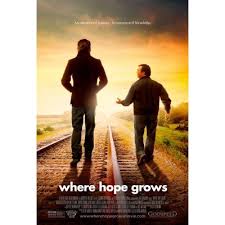 Family movie night at New Life yesterday and we saw a really interesting movie ” Where Hope Grows.” (in the course of this blog I may stray into “spoiler” territory if and when I do so I will proceed this with the word SPOILER and you should stop reading at that point to avoid information that might spoil the movie for you). This is the latest offering from such movies as Courageous and Fireproof. Calvin Thompson is a single father living with his seventeen year old daughter Kate. He was a major league baseball player until his lack of performance resulted in him being kicked off the team . Since then his life has spiralled out of control, fueled largely by the contents of a bottle. At his local supermarket he meets a young man with Downs Syndrome who takes pride in his nick-name -Produce and, of course, he is responsible for the fruit and vegetable displays in the store. The movie chronicles the relationship between Calvin and this grocery store employee, Produce as they become friends and their lives become intertwined. SPOILER
The movie begins by revealing a number of lives largely devoid of hope. Calvin with no hope of any direction, Katie without hope of any change in her father, and Produce with no hope of becoming employee of the month! Calvin sees in Produce, however, an uncanny ability to remain cheerful and positive in any situation and in the end asks Produce what his secret is. Produce never articulates any details but in time asks Calvin if he will give him a lift to church and suggests he might come in. Inevitably Calvin declines choosing rather to join his friend on the golf course. During their round his best friend confronts him as a loser detailing his lack of purpose since leaving the major leagues . Calvin’s violent response leads him into a freefall drunken binge resulting in him lying, passed out on baseball field having missed an interview for a job. As the story proceeds Calvin tentatively approaches Alcoholics Anonymous and things begin to change.
I won’t disclose any more but there are a number of notable aspects of the story. Produce gives a powerful picture of unconditional love as only a person with downs syndrome can. Anyone who has been in contact with one of these wonderful people will inevitably be engulfed in their effortless and irrepressible affection and cheerfulness. For Produce hugs are the order of the day and, as he engages Calvin in unconditional friendship it is hard to avoid being reminded of the unconditional love we are offered in Jesus. When he was asked his secret I wondered, is there anything in my life as a follower of Jesus that would prompt that question of me?
The movie ends not with a death-bed conversion or dramatic life changes (although the end is not what I expected!) but rather in a place where all those who had no hope at the beginning of the story are granted a glimmer of that hope. Kate has her father back, and Calvin has a job. It would seem they have joined Produce at church so we see the seeds of faith beginning to sprout! Yes there is hope for Produce too, but if you want to know about that you will have to see the movie!



 From the Zebra Bag