Archive for the ‘christianity’ Tag
Healing: Living with Faith, Mystery, and Courage
Few subjects stir as much emotion in the church as healing. Because sickness touches every life, the gift of healing feels deeply personal and often painful. It raises hope—but also questions, disappointment, and mystery. Yet healing cannot be ignored. Scripture places it at the very heart of God’s story and the church’s mission.
Healing appears throughout the Bible, from God’s self-revelation as healer in the Old Testament to the ministry of Jesus in the New. The Gospels are filled with accounts of Jesus healing the sick, but Luke 10 is especially striking. There, Jesus commissions not just the Twelve, but seventy-two unnamed disciples to heal the sick and proclaim the nearness of God’s Kingdom. This wider sending points to healing as a normal part of the church’s everyday witness, not a rare or elite activity.
Yet the difficult question remains: if healing is part of God’s Kingdom, why doesn’t everyone get healed? This question has troubled believers throughout history and is closely tied to the broader mystery of unanswered prayer. Jesus consistently linked healing to the coming of the Kingdom of God—a Kingdom that is both “now and not yet.” In Eden, there was no sickness; in the New Creation, there will be none again. The healings we see today are glimpses—tastes—of what is to come. They are signs of God’s future breaking into the present, even while we still live in a broken world.
This tension helps us hold hope and honesty together. Healing sometimes happens, and when it does, it serves as a taste of God’s coming restoration. When it does not, we remain in the mystery of the “not yet.” Even Jesus’ own ministry reflects this tension—most notably at the pool of Bethesda, where only one person was healed.
Jesus healed in many different ways: with a word, a touch, at a distance, even in stages. The common thread was simplicity and authority. He did not use elaborate prayers or perform rituals; he simply said “be healed”. Healing, as one pastor put it, is a profoundly “Jesusie” thing to do.
So why don’t we see it more often today? One reason may be fear—fear of failure, fear of disappointment, fear of trying and not seeing results. Yet Scripture gives us no permission to opt out. While we must accept the mystery, we are still invited to participate.
Healing remains part of the Spirit’s work through the church. Living faithfully in the “not yet” means being willing to try, to pray, and to trust God with the outcome. As followers of Jesus, we are called not just to believe in “Jesus-like” things—but to dare to do them.
Some weeks ago we looked at the subject of discernment. In this sermon we revisit this gift and explore it further through real-life stories, biblical examples, and practical guidance for the life of the church. Discernment is a unique spiritual gift—one acknowledged by both cessationists and continuationists—perhaps because it sits at the very heart of hearing and obeying the Word of God.
While wisdom and prophecy are vital, they are not the same as discernment. Some of the things God calls us to may appear unwise on the surface, and Scripture reminds us to “test the spirits” (1 John 4:1). These realities point clearly to our need for discernment: the ability to recognise what truly is—or is not—the will of God.
When Discernment Is Needed
Two church stories helped illustrate this. One involved the difficult question of whether a church should remain open; the other asked whether two churches should close and allow a new church to be born. In both cases, the issue was not opinion, strategy, or common sense, but a single, defining question: What is God’s will?
Because of that, discernment could not be rushed or handled individually. It required:
• Community – everyone was involved in seeking God together
• Preparation – time set aside for prayer and fasting
• Clearing the ground – laying aside biases, cultural expectations, and personal preferences
• A “prayer of indifference” – a willingness to accept God’s answer, whatever it might be
Only once that central question was answered could the church move on to the “how.”
Discernment vs. Guidance
In the process of forming a new church, working groups explored issues such as a name and a statement of faith. This stage was not discernment but guidance—a sharing of ideas, perspectives, and opinions. Discernment came later, when the community gathered again, prayed, fasted, and asked whether these proposals truly reflected God’s will.
In both major decisions, God gave a clear and confirming “yes.”
Discernment in Scripture
Scripture shows the same patterns at work. In 2 Samuel 16, David refuses to act on cultural instinct or human advice during Absalom’s rebellion. Instead of reacting, he waits to discern what God is wanting him to do. By contrast, Absalom assumes that wise-sounding counsel must be God’s will—and the result is disaster.
In Acts 21, Paul hears repeated prophecies warning him about his journey to Jerusalem. Rather than rejecting them, he discerns their true purpose: not instructions to stop, but warnings to prepare him for what he already knows God has called him to do. Discernment allows Paul to honour the prophetic voices without being led off course.
What We Learn About Discernment
From these stories and passages, several key principles emerge:
• Discernment is needed when we must decide whether a specific action is God’s will, whether we are indeed recognizing Gods voice.
• It is practiced in community, not in isolation
• It requires intentional preparation, perhaps through prayer and fasting, in order to clear out the noise and be able to hear God’d voice
• God is gracious and faithful to confirm His will in different ways.Even when we are unsure, we can trust God to guide, correct, and reassure us
Ultimately, the gift of discernment helps us listen more carefully, act more faithfully, and walk more confidently in obedience to God—especially in moments of uncertainty, transition, and new beginnings.
When we think about the Christmas story, familiar figures quickly come to mind: shepherds, wise men, angels, Mary and Joseph. Yet one vital participant is often overlooked—the Holy Spirit. This sermon invites us to rediscover His central role in the events leading to Jesus’ birth and to reflect on how God’s creative work continues today.
Luke, the Gentile doctor and careful historian, tells us that he set out to write an accurate account of the events “fulfilled” in the life of Jesus (Luke 1:1–4). While we compress the Christmas story into a few festive weeks each December, the reality is far more complex and costly. The events unfolded over many months, in a world marked by political oppression, economic hardship, and deep uncertainty.
To appreciate the Spirit’s work, we rewind not to December, but to “April”—nine months before Jesus’ birth. In the small, insignificant village of Nazareth, the Holy Spirit enters history in a dramatic and unsettling way.
A Disruptive Announcement
Mary, likely no more than 12–14 years old, was betrothed to Joseph in a binding family contract. While this arrangement was normal in her culture, everything else about that day was not. The angel Gabriel—acting under divine direction—appeared to her with astonishing news: she would conceive a child by the Holy Spirit.
For Mary, this “favor” came at immense personal cost. Pregnancy outside of marriage threatened her future, her reputation, and even her life. Confused and disturbed, she questioned how this could happen—she was a virgin. Gabriel’s answer was simple yet staggering: the Holy Spirit would “come upon” her.
This moment echoes the very beginning of Scripture. Just as the Spirit hovered over the chaos at creation (Genesis 1:2), He now hovered over Mary, bringing new life where it seemed impossible. The incarnation itself—the Word becoming flesh—was the climax of the Spirit’s creative work through history.
Confirmation, Joy, and Cost
The Holy Spirit did not leave Mary alone with this impossible calling. Soon after, she visited her cousin Elizabeth, whose own miraculous pregnancy had already begun. When Mary arrived, Elizabeth was filled with the Holy Spirit, the baby in her womb leapt, and she spoke prophetic words that confirmed Mary’s calling.
In response, Mary erupted in praise—the Magnificat—overflowing with joy and worship, even though she knew suffering lay ahead. The Spirit’s work did not remove pain, misunderstanding, or hardship, but He brought assurance, guidance, and deep joy beneath the surface.
In the months and years that followed, the Holy Spirit continued to protect and guide this fragile family—leading them to safety in Egypt and confirming God’s purposes through voices like Simeon and Anna.
What This Means for Us
The lesson is clear: the Holy Spirit is not a background figure in God’s story. He is the ongoing, active agent of God’s creative and redemptive work. He still comes into lives—personal, communal, and even national—to accomplish what seems impossible.
Like Mary, we are invited to trust. God’s favor does not always look comfortable or safe, but it is never without His presence. Beneath the struggle, the Holy Spirit brings reassurance, protection, and joy beyond imagination.
The “forgotten participant” is, in truth, indispensable—and He is still at work today.
I have decided to conduct an experiment and publish summaries of my Sunday sermons in my blog. Please do comment and let me know if you find it interesting and or helpful and, of course, share with others if you think it will bless them.
This sermon is the sixth in a series on the Holy Spirit entitled “The Familiar Stranger” using Tyler Staton’s book of the same name as a framework.
Suffering is a universal part of being human. Every one of us will face pain in some form, and many struggle to understand how a loving Father fits into a world marked by so much hurt. While entire books explore the theology of suffering, this message focuses on one key question: How does the Holy Spirit work within our suffering to bring redemption?
The apostle Paul’s words in Romans 5:1–5 sound almost shocking — rejoicing in suffering. But Paul isn’t celebrating pain. He’s pointing to the mysterious way God takes the brokenness of a fallen world and uses it to form us into people who can live in His Kingdom even as we long for the fullness that is still to come.
Rather than leaning on platitudes, the message turns to real stories of people who faced deep suffering yet discovered God’s redemptive power through the Holy Spirit:
- Joni Eareckson Tada, paralyzed at 17, wrestled with despair and unanswered prayers for healing. Eventually, she prayed, “If you won’t heal me, teach me how to live.” Out of her suffering grew Joni and Friends, a global ministry advocating for people with disabilities.
- Katherine and Jay Wolfe walked through the trauma of Katherine’s massive stroke at age 26. What could have destroyed their family instead gave birth to Hope Heals—a ministry bringing hope, community, and dignity to the disabled and their caregivers.
- Jesus Himself shows the pattern: led by the Holy Spirit into the wilderness, facing rejection, and ultimately entering Gethsemane with anguish. He pleaded three times for another way, yet surrendered to the Father’s will. The resurrection is the ultimate picture of redemptive suffering.
The Holy Spirit doesn’t just redeem suffering on a cosmic scale — He does so personally. The message includes stories of deep personal loss: Sarah’s battle with cancer and Maggie’s tragic loss of her son. These devastating experiences, though still painful, have become part of a story of spiritual formation, hope, and shared healing.
A key truth emerges: redemption often happens in community. When suffering forces us to admit we cannot cope alone, we experience the love of others in transformative ways. The Spirit uses people, presence, and compassion to shape us through our pain.
The conclusion is clear and hope-filled: Suffering is still painful. It’s still wrong. But in the Kingdom of God, evil never gets the last word.
When we allow God into our pain, the Holy Spirit brings surprising, sometimes unimaginable redemption.
In God’s hands, suffering always counts.
I realize that it has been some while since I posted a blog, but I have not felt prompted to write, or maybe I have and I have taken no notice! If it is the latter, please forgive me! However, I wanted to write and share with you something that I shared with those who were with us at New Life Christian Fellowship on Sunday morning. We are currently in a series seeking to deepen our understanding and our day-to-day walk with the Holy Spirit. This series has been inspired by a book by Tyler Staton, “ The Familiar Stranger – re-introducing the Holy Spirit to those in search of an experiential spirituality.“ This is a book I strongly recommend as it addresses one of the most debilitating divisions that we experience in our churches today. Somehow, we have been persuaded that we have to choose between the “Holy Spirit Churches” and the Bible Churches. Tyler makes a powerful case for the equal importance of both and the danger of neglecting either in our personal or church lives.
A life deeply rooted in Scripture is absolutely essential for a healthy relationship to God, self, others, and the world at large. Equally essential, though, is a life deeply rooted in the Holy Spirit, who leads by experience and functions in partnership, not competition, with the explanatory Holy Bible.
A member of our church family made a suggestion that it would be helpful for us to set aside a day during the series for prayer and fasting. An opportunity to hear from the Holy Spirit as a community. We looked at the calendar and selected Saturday, November 29th.
On Sunday morning, however, I believe the Holy Spirit impressed on me that I should go further than simply setting aside a day. I should take my pastoral and leadership responsibility in the same way as the Kings of Israel did at times of great importance, and call everyone who calls New Life Christian Fellowship their church to take this day to pray and fast.
If you are part of the New Life Family, I am doing just that! We will begin the day in the sanctuary at 6:00 am with a time of prayer and worship together, which will last as long as we sense it should. The sanctuary will remain open for prayer until 6:00 pm, when we will break our fast together in the Fellowship Hall. There will be an opportunity to share the things we hear from the Spirit during that time. It is my prayer that there will be at least one person in the sanctuary for the whole of the day.
Now I realize that those of you reading this may not be members of our Church family, and so I have no responsibility to “call” you to anything. However, since I was prompted to write this, I want to suggest that you might find some time, maybe on November 29th, to pray and fast that The Holy Spirit might reveal new ways in which you can partner with Him to serve Him and your local communities at this time of so much need and confusion. I am excited for all of us all to hear from the Holy Spirit in fresh ways and so show the world what it means to be with Jesus, be like Jesus, and do what Jesus did!
I know I have not written for quite some time. This is, at least partly, because I don’t want to burden those kind enough to read my musings with anything that does not seem to have real importance (at least to me!!). I am writing today because I believe that at New Life we have just begun one of the most important preaching series since I became pastor some sixteen years ago. When COV!D -19 broke upon us and we were unable to meet together in church I was convinced at a very early stage that this was going to result in a profound and much-needed change in the church. This was not to cast any unnecessary aspersions on the past but to recognize what many have said: “What got you here will not get you where you are going.” Since that time many of my prayers have been focused on the request that the Father show us what that change was to look like and how we could join Him in bringing the change about.
I am certainly still on that prayerful path but I do believe that coming to a deeper and richer understanding of what it means to be an apprentice (disciple) of Jesus is foundational to us moving forward. In last Sunday’s sermon I shared this quote from Ronald Rolheiser which I think summarizes the challenge before us
We’ve always found it easiest to ignore the truth as long as we never stop moving. In the fall of humanity, we mastered the art of hurry. “And so we end up as good people, but as people who are not very deep: not bad, just busy; not immoral, just distracted; not lacking in soul, just preoccupied; not disdaining depth, just never doing the things to get us there,” Ronald Rolheiser.
When we read how Jesus invited a ramshackle group to follow him and think about how that invitation applies to us, do we really understand the journey that He invited them, and now us, to begin? In his book “Invitation to a Journey” Robert Mulholland says this:
I do not know what your perception of Christian discipleship might be, but much contemporary Christian spirituality tends to view the spiritual life as a static possession rather than a dynamic and ever-developing growth toward wholeness in the image of Christ.
Robert Mulholland
As we study this together ( and we have only just begun) we are seeing that Jesus’ invitation to follow is motivated by His unconditional love for us but as with all invitations we are free to decline. The invitation to follow is rooted in the remarkable Jewish education system. This link takes you to some brilliant teaching on what it meant to be a disciple in Jesus’s day. I encourage you to take the time to listen because it will open your eyes as it did mine to what it meant when we said yes to following Jesus.
However, this is a journey that will last a lifetime. How do we begin? When we have taken the first step of recognizing our sin (the decision to decide for ourselves what is right or wrong) and have accepted the forgiveness purchased for us by Jesus on the cross we must begin to be with Jesus and get to know him. Here is an exercise that you might try to begin the process of getting to know him
Think about your closest friend or spouse and ask yourself how did I get to know them. Try and detail the process as far as you are able and preferably write it down. Then ask how your life of walking with Jesus compares to this and what has helped/hindered you from getting to know Him. Come up with one thing you might do now to help get to know Him better. To make this stick share it with someone you trust and ask them to keep you accountable.
In our Zoom hang out after church on Sunday we were sharing how hard it is for some of us to stay at home and feel like we are doing nothing while some are having to work harder than ever. They’re having to encounter real danger as part of their daily routine. This would have been unthinkable just a few weeks ago let alone when they filled out their application. In the course of the conversation it was pointed out that the reality is, staying at home is, in itself, making a real contribution to stemming the tide of this virus.
As I thought about this later in the day it reminded me of the command God, through Moses, gave to the Israelites as they left Egypt. Confronted with the Red Sea in front of them and an advancing Egyptian army behind them God says “Don’t be afraid, just stand still and watch the Lord rescue you today” Exodus 14:13. In the Psalms, we are urged to “Be still and know that I am God.” The truth is, it’s the “being still” and “standing still” that is so difficult and make us feel that we are not contributing.
Could it be that being and staying still is one of the lessons that we are able to learn by experience as we stay at home? The interesting thing is that I often overlook the rest of Psalm 46:10. It goes on to say “ I will be honored in every nation.” Surely the implication is that if we are not still, we run the risk of getting in the way of His being “honored among the nations.” If the Israelites had decided to take action they would certainly have obstructed the plans that God had for their deliverance. And it was the news of that deliverance that spread among the nations and brought Him honor and glory.
Those of us who play our part by staying at home have the opportunity to understand the “being still” is a crucial part of “knowing He is God” It is just an opportunity to observe. It is by being still when we are told to do so, that we are actively allowing Him to run the universe. Sometimes He asks us to participate, on other occasions he simply asks us to stay out of the way. So to those who are currently staying out of the way, thank you for doing your essential job so well!
A while ago someone I respect asked me if, given my emphatically stated position on keeping politics out of the church, I thought a pastor had any responsibility in advising their congregations on their involvement in the political process. This caused me to think very carefully over recent months and to read fairly widely on the subject of Christians in culture and the public square. The current electoral season has generated a rash of blogs, articles and podcasts on the subject and as a consequence I have reached the conclusion that I should share four principles I believe are firmly based in scripture and that people might find helpful:
1 God is still in charge! Presidents, Prime Ministers, politicians, pastors and the rest of us come and go but God remains entirely and eternally in control. His plan remains unchanged, as it has through the ages, and nothing can deviate Him from its fulfillment.
2 The phrase ” lesser of two evils” is not found or implied anywhere in scripture (to my knowledge). The Bible is clear that all forms of evil come from the forces of darkness and are to be resisted Ephesians 6:10-12. James 4:7
3. The scripture is full of applicable principles and I trust you will search them prayerfully as you ponder these things. In this context I want to share just one:
Know, O people, the Lord has told you what is good,
and this is what he requires of you:
to do what is right, to love mercy,
and to walk humbly with your God. Micah 6:8
4. The fact that someone comes to a different conclusion than you about the application of these, and other biblical principles, does not mean they are bad people neither does it call their relationship with Jesus into question. By God’s grace you will share heaven with many of them, and remember, when the time comes, we will stand before almighty God alone!
I am aware I have on many occasions expressed my relief at not having to make political choices since I am not s citizen. However I have no wish to use this as an excuse not to think and pray for each of you as you think and pray about the choices you must make. To finish I return to where I started, remember, in politics, as in every other aspect of life, God is still in charge and He always will be!
Some times I just like to have a old fashioned book in my hands! I do believe You Version to be one of the greatest gifts that the Body of Christ has received in the recent past. His word is “a lamp unto our feet and light unto our path” to have it readily available on all our mobile devices is an inestimable blessing. However I have to be honest there are occasions when I still love to turn pages and my daily devotional is one of those times. Recently I have been using a devotional book 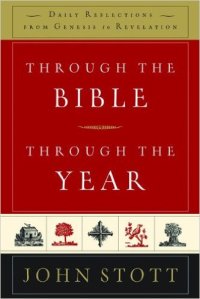 entitled “Through the Bible, Through the Year.” This volume is a selection of writings from the late John Stott.
Sometime ago I wrote that when The Father took John Stott home to be with him we lost one of the most remarkable Biblical expositors of our generation. However Dr Stott was not just a scholar, but also a pastor with a supreme ability to make the most complex Biblical concepts crystal clear. One example to which I refer often is his masterful explanation of Jesus death on the cross for us in ” The Cross of Christ”
“The concept of salvation may be said then to lie at the heart of both sin and salvation. For the essence of sin is man substituting himself for God, while the essence of salvation is God substituting Himself for man. Man asserts himself against God and puts himself where only God deserves to be; God sacrifices Himself for man and puts Himself where only man should be. Man claims prerogatives that belong to God alone and God accepts penalties which belong to man alone”
In this devotional volume,“Through the Bible, Through the Year.” you have the chance to feed on this supreme wisdom day after day. In a single page and few verses each day he unfolds the big story of scripture in a wonderful way and the portion set for each day is brief enough to make it easy to catch up if you get behind. One reason for sharing this now is that he follows a calendar that begins in Genesis next week. The book is laid out in such a way that you can begin at anytime, but to start at the beginning has a certain logic to it! So if you are looking for a real book with pages to turn during a daily devotion, this one will not disappoint I guarantee it!
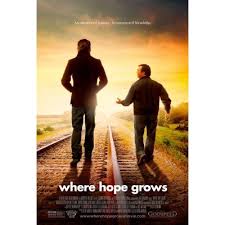 Family movie night at New Life yesterday and we saw a really interesting movie ” Where Hope Grows.” (in the course of this blog I may stray into “spoiler” territory if and when I do so I will proceed this with the word SPOILER and you should stop reading at that point to avoid information that might spoil the movie for you). This is the latest offering from such movies as Courageous and Fireproof. Calvin Thompson is a single father living with his seventeen year old daughter Kate. He was a major league baseball player until his lack of performance resulted in him being kicked off the team . Since then his life has spiralled out of control, fueled largely by the contents of a bottle. At his local supermarket he meets a young man with Downs Syndrome who takes pride in his nick-name -Produce and, of course, he is responsible for the fruit and vegetable displays in the store. The movie chronicles the relationship between Calvin and this grocery store employee, Produce as they become friends and their lives become intertwined. SPOILER
The movie begins by revealing a number of lives largely devoid of hope. Calvin with no hope of any direction, Katie without hope of any change in her father, and Produce with no hope of becoming employee of the month! Calvin sees in Produce, however, an uncanny ability to remain cheerful and positive in any situation and in the end asks Produce what his secret is. Produce never articulates any details but in time asks Calvin if he will give him a lift to church and suggests he might come in. Inevitably Calvin declines choosing rather to join his friend on the golf course. During their round his best friend confronts him as a loser detailing his lack of purpose since leaving the major leagues . Calvin’s violent response leads him into a freefall drunken binge resulting in him lying, passed out on baseball field having missed an interview for a job. As the story proceeds Calvin tentatively approaches Alcoholics Anonymous and things begin to change.
I won’t disclose any more but there are a number of notable aspects of the story. Produce gives a powerful picture of unconditional love as only a person with downs syndrome can. Anyone who has been in contact with one of these wonderful people will inevitably be engulfed in their effortless and irrepressible affection and cheerfulness. For Produce hugs are the order of the day and, as he engages Calvin in unconditional friendship it is hard to avoid being reminded of the unconditional love we are offered in Jesus. When he was asked his secret I wondered, is there anything in my life as a follower of Jesus that would prompt that question of me?
The movie ends not with a death-bed conversion or dramatic life changes (although the end is not what I expected!) but rather in a place where all those who had no hope at the beginning of the story are granted a glimmer of that hope. Kate has her father back, and Calvin has a job. It would seem they have joined Produce at church so we see the seeds of faith beginning to sprout! Yes there is hope for Produce too, but if you want to know about that you will have to see the movie!


