Archive for the ‘Hope’ Tag
Your Highest Goal: Making Love the Center of the Christian Life
Love is arguably the word most used—and with the widest range of definitions in our culture. From song lyrics to Valentine’s Day celebrations, everyone talks about love, yet defining it proves surprisingly difficult. Ask a room full of people what love means, and you’re likely to get answers “all over the map.”
Yet Scripture makes it clear that love is not a vague or optional idea. The word love appears repeatedly throughout the Gospels—78 times in total, with a striking concentration in John chapters 13–17. These are Jesus’ own words, spoken at the most intimate moment with His disciples. From the very beginning, John tells us that God’s love entered the world through Jesus (John 1:17). When Jesus is asked to identify the greatest commandment, He responds that loving God fully and loving our neighbour as ourselves sums up the entire Law and the Prophets (Matthew 22:38–40). Later, He gives His disciples a “new command”: to love one another as He has loved them—declaring that this love will be the defining mark of His followers (John 13:33–34).
Clearly, love sits at the very heart of apprenticeship to Jesus.
The apostles understood this as well. The letters of the New Testament use the word love over 170 times. In addressing the Corinthian church’s understanding of spiritual gifts, Paul makes a striking statement: “Make love your highest goal” (1 Corinthians 14:1). He devotes an entire chapter—1 Corinthians 13—to explaining that love is the foundation for all the work of the Holy Spirit. Without love, even the most impressive spiritual activity amounts to nothing.
Because love is so central to Jesus’ teaching and the life of the Church, this new series sets out to go deeper—not only to understand what love is, but to learn how we can become people who are genuinely characterised by it.
One challenge we face is that most modern definitions of love focus on feelings and emotions—things we cannot control or command. As Dharius Daniels in his book “re-Presenting Jesus “observes, “feelings can be managed but not commanded“. This creates a problem, because Jesus does command us to love, and to love in the way He loves (John 15:17). That means love as Jesus demonstrated must be more than emotion; it must be something visible, intentional, and embodied.
The New Testament most often uses the Greek word agape to describe God’s love. Rather than defining it abstractly, the best way to understand agape is by looking at the life of Jesus Himself. Over the coming weeks, this series will do exactly that—examining how Jesus lives out love, using 1 Corinthians 13:4–6 as a lens through which to observe His actions and character.
To help frame this journey, a working definition of love—drawn from Jesus’ life and the wisdom of Scripture—has been introduced and will remain visible throughout the series, open to refinement as we continue learning together. Agape-To make an absolute priority of, and to work relentlessly for, the absolute best for another person(s) without expecting a return
To launch this exploration, the sermon concludes in an unusual way: with a story. Stories often reveal truth more powerfully than explanations, and few modern writers capture the lived reality of love better than Bob Goff. The opening story from his book Love Does offers a compelling picture of what it looks like when love moves beyond words and becomes action—a fitting invitation into a series devoted to making love our highest goal.
Healing: Living with Faith, Mystery, and Courage
Few subjects stir as much emotion in the church as healing. Because sickness touches every life, the gift of healing feels deeply personal and often painful. It raises hope—but also questions, disappointment, and mystery. Yet healing cannot be ignored. Scripture places it at the very heart of God’s story and the church’s mission.
Healing appears throughout the Bible, from God’s self-revelation as healer in the Old Testament to the ministry of Jesus in the New. The Gospels are filled with accounts of Jesus healing the sick, but Luke 10 is especially striking. There, Jesus commissions not just the Twelve, but seventy-two unnamed disciples to heal the sick and proclaim the nearness of God’s Kingdom. This wider sending points to healing as a normal part of the church’s everyday witness, not a rare or elite activity.
Yet the difficult question remains: if healing is part of God’s Kingdom, why doesn’t everyone get healed? This question has troubled believers throughout history and is closely tied to the broader mystery of unanswered prayer. Jesus consistently linked healing to the coming of the Kingdom of God—a Kingdom that is both “now and not yet.” In Eden, there was no sickness; in the New Creation, there will be none again. The healings we see today are glimpses—tastes—of what is to come. They are signs of God’s future breaking into the present, even while we still live in a broken world.
This tension helps us hold hope and honesty together. Healing sometimes happens, and when it does, it serves as a taste of God’s coming restoration. When it does not, we remain in the mystery of the “not yet.” Even Jesus’ own ministry reflects this tension—most notably at the pool of Bethesda, where only one person was healed.
Jesus healed in many different ways: with a word, a touch, at a distance, even in stages. The common thread was simplicity and authority. He did not use elaborate prayers or perform rituals; he simply said “be healed”. Healing, as one pastor put it, is a profoundly “Jesusie” thing to do.
So why don’t we see it more often today? One reason may be fear—fear of failure, fear of disappointment, fear of trying and not seeing results. Yet Scripture gives us no permission to opt out. While we must accept the mystery, we are still invited to participate.
Healing remains part of the Spirit’s work through the church. Living faithfully in the “not yet” means being willing to try, to pray, and to trust God with the outcome. As followers of Jesus, we are called not just to believe in “Jesus-like” things—but to dare to do them.
Some weeks ago we looked at the subject of discernment. In this sermon we revisit this gift and explore it further through real-life stories, biblical examples, and practical guidance for the life of the church. Discernment is a unique spiritual gift—one acknowledged by both cessationists and continuationists—perhaps because it sits at the very heart of hearing and obeying the Word of God.
While wisdom and prophecy are vital, they are not the same as discernment. Some of the things God calls us to may appear unwise on the surface, and Scripture reminds us to “test the spirits” (1 John 4:1). These realities point clearly to our need for discernment: the ability to recognise what truly is—or is not—the will of God.
When Discernment Is Needed
Two church stories helped illustrate this. One involved the difficult question of whether a church should remain open; the other asked whether two churches should close and allow a new church to be born. In both cases, the issue was not opinion, strategy, or common sense, but a single, defining question: What is God’s will?
Because of that, discernment could not be rushed or handled individually. It required:
• Community – everyone was involved in seeking God together
• Preparation – time set aside for prayer and fasting
• Clearing the ground – laying aside biases, cultural expectations, and personal preferences
• A “prayer of indifference” – a willingness to accept God’s answer, whatever it might be
Only once that central question was answered could the church move on to the “how.”
Discernment vs. Guidance
In the process of forming a new church, working groups explored issues such as a name and a statement of faith. This stage was not discernment but guidance—a sharing of ideas, perspectives, and opinions. Discernment came later, when the community gathered again, prayed, fasted, and asked whether these proposals truly reflected God’s will.
In both major decisions, God gave a clear and confirming “yes.”
Discernment in Scripture
Scripture shows the same patterns at work. In 2 Samuel 16, David refuses to act on cultural instinct or human advice during Absalom’s rebellion. Instead of reacting, he waits to discern what God is wanting him to do. By contrast, Absalom assumes that wise-sounding counsel must be God’s will—and the result is disaster.
In Acts 21, Paul hears repeated prophecies warning him about his journey to Jerusalem. Rather than rejecting them, he discerns their true purpose: not instructions to stop, but warnings to prepare him for what he already knows God has called him to do. Discernment allows Paul to honour the prophetic voices without being led off course.
What We Learn About Discernment
From these stories and passages, several key principles emerge:
• Discernment is needed when we must decide whether a specific action is God’s will, whether we are indeed recognizing Gods voice.
• It is practiced in community, not in isolation
• It requires intentional preparation, perhaps through prayer and fasting, in order to clear out the noise and be able to hear God’d voice
• God is gracious and faithful to confirm His will in different ways.Even when we are unsure, we can trust God to guide, correct, and reassure us
Ultimately, the gift of discernment helps us listen more carefully, act more faithfully, and walk more confidently in obedience to God—especially in moments of uncertainty, transition, and new beginnings.
When we think about the Christmas story, familiar figures quickly come to mind: shepherds, wise men, angels, Mary and Joseph. Yet one vital participant is often overlooked—the Holy Spirit. This sermon invites us to rediscover His central role in the events leading to Jesus’ birth and to reflect on how God’s creative work continues today.
Luke, the Gentile doctor and careful historian, tells us that he set out to write an accurate account of the events “fulfilled” in the life of Jesus (Luke 1:1–4). While we compress the Christmas story into a few festive weeks each December, the reality is far more complex and costly. The events unfolded over many months, in a world marked by political oppression, economic hardship, and deep uncertainty.
To appreciate the Spirit’s work, we rewind not to December, but to “April”—nine months before Jesus’ birth. In the small, insignificant village of Nazareth, the Holy Spirit enters history in a dramatic and unsettling way.
A Disruptive Announcement
Mary, likely no more than 12–14 years old, was betrothed to Joseph in a binding family contract. While this arrangement was normal in her culture, everything else about that day was not. The angel Gabriel—acting under divine direction—appeared to her with astonishing news: she would conceive a child by the Holy Spirit.
For Mary, this “favor” came at immense personal cost. Pregnancy outside of marriage threatened her future, her reputation, and even her life. Confused and disturbed, she questioned how this could happen—she was a virgin. Gabriel’s answer was simple yet staggering: the Holy Spirit would “come upon” her.
This moment echoes the very beginning of Scripture. Just as the Spirit hovered over the chaos at creation (Genesis 1:2), He now hovered over Mary, bringing new life where it seemed impossible. The incarnation itself—the Word becoming flesh—was the climax of the Spirit’s creative work through history.
Confirmation, Joy, and Cost
The Holy Spirit did not leave Mary alone with this impossible calling. Soon after, she visited her cousin Elizabeth, whose own miraculous pregnancy had already begun. When Mary arrived, Elizabeth was filled with the Holy Spirit, the baby in her womb leapt, and she spoke prophetic words that confirmed Mary’s calling.
In response, Mary erupted in praise—the Magnificat—overflowing with joy and worship, even though she knew suffering lay ahead. The Spirit’s work did not remove pain, misunderstanding, or hardship, but He brought assurance, guidance, and deep joy beneath the surface.
In the months and years that followed, the Holy Spirit continued to protect and guide this fragile family—leading them to safety in Egypt and confirming God’s purposes through voices like Simeon and Anna.
What This Means for Us
The lesson is clear: the Holy Spirit is not a background figure in God’s story. He is the ongoing, active agent of God’s creative and redemptive work. He still comes into lives—personal, communal, and even national—to accomplish what seems impossible.
Like Mary, we are invited to trust. God’s favor does not always look comfortable or safe, but it is never without His presence. Beneath the struggle, the Holy Spirit brings reassurance, protection, and joy beyond imagination.
The “forgotten participant” is, in truth, indispensable—and He is still at work today.
I have decided to conduct an experiment and publish summaries of my Sunday sermons in my blog. Please do comment and let me know if you find it interesting and or helpful and, of course, share with others if you think it will bless them.
This sermon is the sixth in a series on the Holy Spirit entitled “The Familiar Stranger” using Tyler Staton’s book of the same name as a framework.
Suffering is a universal part of being human. Every one of us will face pain in some form, and many struggle to understand how a loving Father fits into a world marked by so much hurt. While entire books explore the theology of suffering, this message focuses on one key question: How does the Holy Spirit work within our suffering to bring redemption?
The apostle Paul’s words in Romans 5:1–5 sound almost shocking — rejoicing in suffering. But Paul isn’t celebrating pain. He’s pointing to the mysterious way God takes the brokenness of a fallen world and uses it to form us into people who can live in His Kingdom even as we long for the fullness that is still to come.
Rather than leaning on platitudes, the message turns to real stories of people who faced deep suffering yet discovered God’s redemptive power through the Holy Spirit:
- Joni Eareckson Tada, paralyzed at 17, wrestled with despair and unanswered prayers for healing. Eventually, she prayed, “If you won’t heal me, teach me how to live.” Out of her suffering grew Joni and Friends, a global ministry advocating for people with disabilities.
- Katherine and Jay Wolfe walked through the trauma of Katherine’s massive stroke at age 26. What could have destroyed their family instead gave birth to Hope Heals—a ministry bringing hope, community, and dignity to the disabled and their caregivers.
- Jesus Himself shows the pattern: led by the Holy Spirit into the wilderness, facing rejection, and ultimately entering Gethsemane with anguish. He pleaded three times for another way, yet surrendered to the Father’s will. The resurrection is the ultimate picture of redemptive suffering.
The Holy Spirit doesn’t just redeem suffering on a cosmic scale — He does so personally. The message includes stories of deep personal loss: Sarah’s battle with cancer and Maggie’s tragic loss of her son. These devastating experiences, though still painful, have become part of a story of spiritual formation, hope, and shared healing.
A key truth emerges: redemption often happens in community. When suffering forces us to admit we cannot cope alone, we experience the love of others in transformative ways. The Spirit uses people, presence, and compassion to shape us through our pain.
The conclusion is clear and hope-filled: Suffering is still painful. It’s still wrong. But in the Kingdom of God, evil never gets the last word.
When we allow God into our pain, the Holy Spirit brings surprising, sometimes unimaginable redemption.
In God’s hands, suffering always counts.
I know I have not written for quite some time. This is, at least partly, because I don’t want to burden those kind enough to read my musings with anything that does not seem to have real importance (at least to me!!). I am writing today because I believe that at New Life we have just begun one of the most important preaching series since I became pastor some sixteen years ago. When COV!D -19 broke upon us and we were unable to meet together in church I was convinced at a very early stage that this was going to result in a profound and much-needed change in the church. This was not to cast any unnecessary aspersions on the past but to recognize what many have said: “What got you here will not get you where you are going.” Since that time many of my prayers have been focused on the request that the Father show us what that change was to look like and how we could join Him in bringing the change about.
I am certainly still on that prayerful path but I do believe that coming to a deeper and richer understanding of what it means to be an apprentice (disciple) of Jesus is foundational to us moving forward. In last Sunday’s sermon I shared this quote from Ronald Rolheiser which I think summarizes the challenge before us
We’ve always found it easiest to ignore the truth as long as we never stop moving. In the fall of humanity, we mastered the art of hurry. “And so we end up as good people, but as people who are not very deep: not bad, just busy; not immoral, just distracted; not lacking in soul, just preoccupied; not disdaining depth, just never doing the things to get us there,” Ronald Rolheiser.
When we read how Jesus invited a ramshackle group to follow him and think about how that invitation applies to us, do we really understand the journey that He invited them, and now us, to begin? In his book “Invitation to a Journey” Robert Mulholland says this:
I do not know what your perception of Christian discipleship might be, but much contemporary Christian spirituality tends to view the spiritual life as a static possession rather than a dynamic and ever-developing growth toward wholeness in the image of Christ.
Robert Mulholland
As we study this together ( and we have only just begun) we are seeing that Jesus’ invitation to follow is motivated by His unconditional love for us but as with all invitations we are free to decline. The invitation to follow is rooted in the remarkable Jewish education system. This link takes you to some brilliant teaching on what it meant to be a disciple in Jesus’s day. I encourage you to take the time to listen because it will open your eyes as it did mine to what it meant when we said yes to following Jesus.
However, this is a journey that will last a lifetime. How do we begin? When we have taken the first step of recognizing our sin (the decision to decide for ourselves what is right or wrong) and have accepted the forgiveness purchased for us by Jesus on the cross we must begin to be with Jesus and get to know him. Here is an exercise that you might try to begin the process of getting to know him
Think about your closest friend or spouse and ask yourself how did I get to know them. Try and detail the process as far as you are able and preferably write it down. Then ask how your life of walking with Jesus compares to this and what has helped/hindered you from getting to know Him. Come up with one thing you might do now to help get to know Him better. To make this stick share it with someone you trust and ask them to keep you accountable.
 I have not written for while mostly because the relentless cacophony of opinions and perspectives that assault us on every subject under the sun has been somewhat overwhelming.
I have been reading ” Mobilizing Hope – Faith Inspired Activism for a Post Civil Rights Generation” by Adam Taylor* and I came across this wonderful devotion from Howard Thurman’s “Meditations of the Heart” that I thought I would share with you:
How good it is to center down!
The streets of our minds seethe with endless traffic;
Our spirits resound with clashings, with noisy silences,
While something deep within hungers and thirsts for the still moment
and the resting lull.
With full intensity we seek, ere the quiet passes, a fresh sense
of order in our living;
A direction, a strong sure purpose that will structure our confusion
and bring meaning in our chaos.
We look at ourselves in this waiting moment –
the kinds of people we are.
The questions persist: what are we doing with our lives? –
what are the motives that order our days?
What is the end of our doings?
Where are we trying to go?
Where do we put the emphasis and where are our values focused?
For what end do we make sacrifices?
Where is my treasure and what do I love most in life?
What do I hate most in life and to what am I true?
Over and over the questions beat in upon the waiting moment.
As we listen, floating up through all the jangling echoes of our turbulence,
there is a sound of another kind –
A deeper note which only the stillness of the heart makes clear.
It moves directly to the core of our being.
Our questions are answered,
Our spirits refreshed, and we move back into the traffic of our daily round
With the peace of the Eternal in our step.
How good it is to center down!
Howard Thurman
*( By the way this book has one of the best chapters on Racial Reconciliation and Racial Justice I have read)
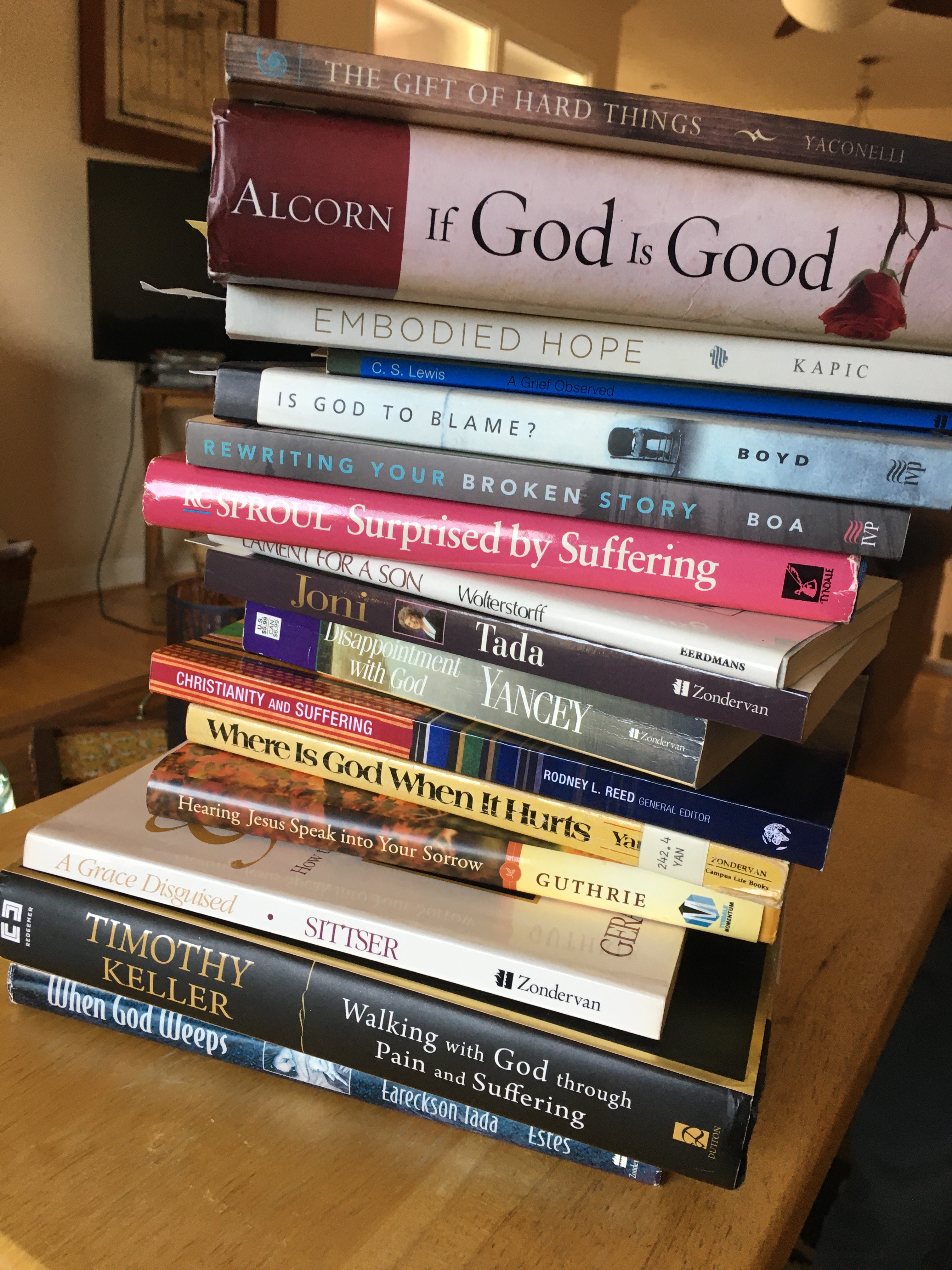 As I began the series on The Paradox of Suffering last Sunday I mentioned that I might share here some of the books I have been reading in preparation for the series. That idea seemed to be greeted with enthusiasm so here it is! Needless to say, I have not read all of each of these books in the last few weeks but all have, over the years contributed to my thinking on this subject. (Please do add any others that have been helpful to you in the comment section and then share so others can benefit)
If God is Good- Faith in the midst of suffering and evil by Randy Alcorn https://www.amazon.com/dp/B002OK2OPS/ref=dp-kindle-redirect?_encoding=UTF8&btkr=1
Walking with God through Pain and Suffering by Timothy Keller https://www.amazon.com/dp/B00C1N951O/ref=dp-kindle-redirect?_encoding=UTF8&btkr=1
Embodied Hope- a theological meditation on pain and suffering by Kelley M Kapic https://www.amazon.com/dp/B073H5JY6T/ref=dp-kindle-redirect?_encoding=UTF8&btkr=1
A Grief Observed by CS Lewis https://www.amazon.com/Grief-Observed-C-S-Lewis-ebook/dp/B002BXH5WU
Is God to Blame? -beyond pat answers to the problem of suffering by Gregory a Boyd https://www.amazon.com/dp/B001HL0EXE/ref=dp-kindle-redirect?_encoding=UTF8&btkr=1
Rewriting Your Broken Story- the power of an eternal perspective by Kenneth Boa
https://www.amazon.com/dp/B01D8W4IKY/ref=dp-kindle-redirect?_encoding=UTF8&btkr=1
Shaped by Suffering- how temporary hardships prepare us for our eternal home by Kenneth Boa https://www.amazon.com/dp/B07V4T9FFC/ref=dp-kindle-redirect?_encoding=UTF8&btkr=1
Surprised by Suffering by RC Sproul https://www.amazon.com/dp/B0038OMK9Y/ref=dp-kindle-redirect?_encoding=UTF8&btkr=1
Lament for a Son by Nicholas Wolterstorff https://www.amazon.com/dp/B001E96QOU/ref=dp-kindle-redirect?_encoding=UTF8&btkr=1
Joni -an unforgettable story by Joni Eareckson Tada
https://bit.ly/2VNjbA3
Disappointment with God- Three questions no one asks aloud by Philip Yancey https://www.amazon.com/dp/B00UF72CMC/ref=dp-kindle-redirect?_encoding=UTF8&btkr=1
Where is God when it Hurts by Philip Yancey
https://bit.ly/2VJ7Gto
Christianity and Suffering- African perspectives Rodney L Reed general editor https://www.amazon.com/dp/B079GVPFJX/ref=dp-kindle-redirect?_encoding=UTF8&btkr=1
Hearing Jesus Speak into your Sorrow by Nancy Guthrie https://www.amazon.com/Hearing-Jesus-Speak-into-Sorrow/dp/1414325487
A Grace Disguised-how the soul grows through loss by Gerald L Sittser https://www.amazon.com/dp/B001UFMUE8/ref=dp-kindle-redirect?_encoding=UTF8&btkr=1
When God Weeps -why our suffering matters to the Almighty by Joni Erickson Todda and Steven Estes https://www.amazon.com/dp/B003OYIA3I/ref=dp-kindle-redirect?_encoding=UTF8&btkr=1
Dark Clouds, Deep Mercy – discovering the grace of lament by Mark Vroegop https://www.amazon.com/dp/B07JDDSSW9/ref=dp-kindle-redirect?_encoding=UTF8&btkr=1
Tracks of a Fellow Struggler -Living and Growing through Grief by John R. Claypool https://www.amazon.com/dp/B00295R60G/ref=dp-kindle-redirect?_encoding=UTF8&btkr=1
The Gift of Hard Things- finding grace in unexpected places by Mark Yaconelli https://www.amazon.com/dp/B01D8W6IZW/ref=dp-kindle-redirect?_encoding=UTF8&btkr=1
Hope Heals – A True story of Overwhelming Loss and overcoming Love by Katherine Wolf
https://amzn.to/2XX0gWg
What Does The Bible Say about Suffering -Brian Han Gregg
https://amzn.to/2VtBefv
(If you consider purchasing any of these for yourself and you live in Pacifica, remember that Florey’s Books is a local store that very much needs our support at this time)
I saw a striking post on face book posing the question if our professional sports stars are not essential why are they our heroes and why do they get paid so much? Interesting thought, but surely a more interesting one is about those largely unknown people who have suddenly become our heroes. The grocery clerks, healthcare aids, teacher/Moms and so many others. These people and many others like them have been plummeted into the front line where there is real danger and the need to work harder than ever.
One of our church family posted this wonderful prayer for these unsung heroes and in case you missed it I wanted to share it with you. The question is how can we make sure that these people each of whom has a name, who were serving us faithfully before this crisis are not taken for granted in the future?
Bless the merciful
A Sunday Blessing
By: Sarah Bessey
March 29, 2020
Oh, God. Bless the merciful. Bless them.
Bless the hospital chaplains who are crying and praying in trauma rooms with the scared and the hurting. Bless the doctors and the nurses, the janitors and the lunch ladies, the front-line workers and behind the scenes faithful ones during this terrible time. Bless the ones in the nursing homes with lonely seniors, putting themselves at risk to keep caring for the vulnerable. Bless the families on the other side of the window glass with phones, smiling and waving and holding up signs of love to their elders. Bless the vulnerable and at-risk and those who open their doors to them even in the midst of a pandemic. Bless the scared kids and the adults who notice them.
Bless the ones who cry too much and feel too much. Bless the wounded healers.
Bless the kind ones, who speak words of life and gentleness. Bless the benefit-of-the-doubt givers, the one-more-chance lavishers. Bless the comforters and the kleenex-passers. Bless the walkers-in-another’s-shoes. Bless the wheelchair pushers. Bless the ones there waiting after the chips fall, and the edifice crumbles, and the truth comes out. Bless them for their grace for both the flyers and the thud-ers, for the fury and the glory. Bless the ones baking bread and leaving it on doorsteps for the parents they can’t risk seeing. Bless the ones who serve without fanfare or book deals or media attention. Bless the ones who love vulnerable children, day after day after day. Bless the ones who are lonely and alone, who are isolated and vulnerable, who are struggling to breathe.
Bless the ones who lavish grace and bandage wounds and figure out how to make ventilators in factories. Bless the ones who intubate and the ones who are crying in the stairwell, overwhelmed by caring. Bless them for they give dignity to the rest of us. Bless them because they see us and they love us anyway.
Bless them for standing in our thin places between too-much and not-enough, the places where our hearts are breaking and our fears are manifesting and we are so scared and so alone. Bless them for being the ones that show up in the fault lines to hold our hands and pray and weep with those who weep.
Bless them for their patience, for their uncanny ability to just keep going, for their ability to be present instead of checking out for something less demanding. Bless them for long days on their feet in uncomfortable PPE gear, sweaty and exhausted and filled with mercy for us anyway. Bless them for their determination in the face of suffering, for the patience in the teeth of our it’s-going-to-get-worse predictions, and their faith in our story.
Bless them for their heart to ease the suffering, to smooth the edges, widen the roads. Bless them for their cups of cold water, and their plates of food, for their prison visiting, for their preemie-baby hat knitting, for the signs in the windows saying “thank you, essential workers!” decorated with stickers and glitter. Bless them for the healing work of their gifts. Bless them when they smell of salt tears and someone else’s sh** and our unwashed bodies. Bless the funeral workers and the priests who have run out of words. Bless the journalists and politicians who are wise and merciful, the public health officials and the sign language interpreters. Bless the site preppers and the cleaners. Bless the merciful because they are so often the only glimpse of goodness.
Bless the merciful as they carry our own burdens with us; we cannot know how low they are bowed with the grief of the whole world groaning for healing and hope even as they keep moving forward. Bless them in their anger. Bless them in their frustrations. Bless them in their fears. Bless them in their exhaustion. Bless them when they are overwhelmed and want to quit. Bless their sleep and their rising.
Bless the ones who care for the ageing and the dying, for those making the way a bit smoother for the families left behind. Bless the ones who hold the hands of the poor and broken and you and me. Bless the ones running right towards the hurting with their hands outstretched.
At the end of all this may we bless them with rest and gratitude, with compassionate and generous policies and pay, with just systems and actions. At the end of all this, may they know they were our heroes not in spite of their weakness and humanity and moments of breaking but because of them. At the end of this, may we value love and mercy.
Bless them because it takes more courage and strength to be merciful, compassionate, and kind than we could have ever imagined. May they find love and strength, courage and compassion at their rock bottom.
In our Zoom hang out after church on Sunday we were sharing how hard it is for some of us to stay at home and feel like we are doing nothing while some are having to work harder than ever. They’re having to encounter real danger as part of their daily routine. This would have been unthinkable just a few weeks ago let alone when they filled out their application. In the course of the conversation it was pointed out that the reality is, staying at home is, in itself, making a real contribution to stemming the tide of this virus.
As I thought about this later in the day it reminded me of the command God, through Moses, gave to the Israelites as they left Egypt. Confronted with the Red Sea in front of them and an advancing Egyptian army behind them God says “Don’t be afraid, just stand still and watch the Lord rescue you today” Exodus 14:13. In the Psalms, we are urged to “Be still and know that I am God.” The truth is, it’s the “being still” and “standing still” that is so difficult and make us feel that we are not contributing.
Could it be that being and staying still is one of the lessons that we are able to learn by experience as we stay at home? The interesting thing is that I often overlook the rest of Psalm 46:10. It goes on to say “ I will be honored in every nation.” Surely the implication is that if we are not still, we run the risk of getting in the way of His being “honored among the nations.” If the Israelites had decided to take action they would certainly have obstructed the plans that God had for their deliverance. And it was the news of that deliverance that spread among the nations and brought Him honor and glory.
Those of us who play our part by staying at home have the opportunity to understand the “being still” is a crucial part of “knowing He is God” It is just an opportunity to observe. It is by being still when we are told to do so, that we are actively allowing Him to run the universe. Sometimes He asks us to participate, on other occasions he simply asks us to stay out of the way. So to those who are currently staying out of the way, thank you for doing your essential job so well!


 From the Zebra Bag