Archive for the ‘Uncategorized’ Category
I promised further insight from“Thanks for the Feedback” by Sheila Heen and Douglas Stone, so here is part 2
It would seem that there may be more to learn about receiving feedback than we first think (See post 8/15). At the end of their first chapter Heen and Stone ask this question ” Why is it that when we give feedback we often feel so right, yet when we receive feedback it so often feels wrong?” A more detailed look at the “triggers” enumerated in my last post will help. In order to give more objective attention to the feedback we receive, we must first be able to recognize the type of feedback we are receiving. The authors list three; Appreciation, Coaching and Evaluation. The first, appreciation, is about our relationship with the giver. An indication that the hard work one has done is valued or simply that they like to have you around! Coaching often takes the form of helpful, constructive suggestions about how something can be improved. Evaluation is simply a statement of performance against a known standard. All three types of feedback are extremely valuable in the right context, but when we expect or want one type and get another, our response can range from frustration to anger and hurt. When we just need someone to tell us they value us and they give us some handy tips on cooking steak, or indeed when we would value some help and all that is forthcoming is an “attaboy” we are left disappointed! Whereas it maybe difficult to avoid negative responses altogether, being conscious of the type of feedback we are seeking and recognizing the type we are in fact getting can at least help>
We have all been told many times that it is better to give than receive, but is that always true? John Gottman, a marriage researcher, has found that a person’s willingness to receive and accept influence (feedback) from their spouse is a key predictor of a healthy, stable marriage. I can recall receiving professional feedback that for some reason lived on in my mind for years. For parents it is frightening to realize that our children will learn how to respond to correction and coaching by watching our responses to the various forms of feedback we receive. All this would suggest that the art of receiving feedback might be more important that we think.
In their recent book “Thanks for the Feedback” Sheila Heen and Douglas Stone‘s research indicates that this is indeed true. At the recent the Global Leadership Summit Sheila taught on the subject. Her content was so compelling that I immediately purchased the book and I want to share some of the lessons I am learning as I read.
Whether it is graded assignments at school, “likes” on our facebook posts or simply a warm smile when enjoying a carefully prepared meal, feed back washes over us from all sides. Our reactions can range from joy to anger and there is much we can learn that will help us both understand our responses and handle them more constructively. Firstly feed back is received at the intersection of two of our most fundamental needs, our desire to learn and improve and our yearning to be accepted and loved as we are. Many of our negative reactions are caused by a series of what the authors call “triggers”. “Truth triggers” are set off by a sense that the content of the feedback is somehow without substance while “Relationship Triggers” are a consequence of the type of relationship we have with the person offering the feed back. “Identity Triggers” result in us doubting who we are and shaking all our insecurities regardless of the content of the message. Without exception when these triggers are activated we are disabled from any constructive conversation about the content of the feedback itself. However when we recognize their existence and are ready for them we have a much better chance of benefiting from what is said. If we do indeed want to learn and improve there is of course much more to come so watch this space for more nuggets from this excellent book.
The following is an extract from a blog (you can read the full text here). The opening describes a wonderful wedding where all aspects off the wedding were provided by the couples friends. Wonderful yes but not that unusual you might say. I agree but these thoughts that follow I believe really challenge us to think about the day to day practical meaning and cost of living the life described in Acts 4:32-35. So often when I read these verses I ask myself what would “everything in common” really look like today, I think this at least gives food for though in answering the question…
…You see, it’s now one week on and our shoulders are still aching from the lifting and carrying of chairs, drinks, tables and amps. The photographer is still selecting and touching up photos for their album (not that the beautiful couple need it, of course). And, I would wager, that most people involved have found themselves still sneaking the odd yawn or tired glance at the clock in the last few days to see if it’s bedtime yet.
Living in community sounds great! So Christians often look to Acts and aspire to the type of living that “shared and sold possessions to give to anyone in need” or “had everything in common”.
It sounds amazing, like a glimpse of heaven. Yet we often stop short. We blame the modern pace of life, or practical issues like work, family, the mortgage. We tell ourselves: “It’s a nice idea, but we probably need to re-contextualise it for a 21st century view of community”.
And yet, in reality, I wonder if it’s just too hard and we’re too scared to admit it.
When you share or sell possessions, you decide that those things you own aren’t yours anymore and you no longer own them. Skills and talents can be the same; they belong to everyone and are there to be shared. Being together means not being elsewhere – and that can be costly. It includes being present when you are together and not caught up in emails, social media or some other phone-based pursuit. Holding everything in common means letting go of some of your own pre-conceptions, firmly held ideas and ways of doing things. It also means taking time to listen, allowing others the chance to shape the direction of your community and help point to the future.
And so we read Acts, longingly wishing there was just a way we could get there, and perhaps secretly hoping we never have to. Saving ourselves from the hard work, late nights, tough conversations, aching shoulders – all the tough stuff really living in community might cost us.
So what do you think, does that help to make it real and are we willing to count and pay the cost?
The above is taken from a a multi author blog entitled “threads”
Over recent years Good Friday has become an increasingly important day for me. Last year I wrote a piece that explained my feelings that an Easter Sunday celebration was significantly muted if one does not take time to absorb the full significance of Good Friday. Each year part of my Good Friday has been a service with two other churches in Pacifica. This year as I prepared for that event, particularly focussed on those last word of Jesus “ It is finished” I was impressed by a perspective I had not really seen before.
There were three (at least) groups of people on that hill outside Jerusalem that Friday. The first was a gathering of religious authority figures. For them this was finally the end of three years of chaos (or at least so they hoped). For the past month this self styled Rabbi had travelled their jurisdiction, proclaiming a radical and disruptive message. Every aspect of this message seemed to discredit them and all they stood for. Every time they confronted him they were humiliated and to add insult to injury he claimed to be God! They must have been glad to hear the words “ It is finished.”
And then there were his friends and family. They had struggled and stumbled along beside him, asking questions, and at least reserving judgment as far as they could. Step by step however they had moved towards the belief that he was at the least a remarkable prophet and at best the Messiah of their hopes and dreams. Imminent, they had begun to believe, was that moment when he would declare the end of Roman tyranny and the Jewish nation would be free again. For them the sight of that body slumped lifeless on a cross meant that all they and dared to hope was finished. Disappointment, confusion, anger, and humiliation it was all there. How could they have let themselves give room to that hope? And lastly a tired, surly group of Roman soldiers reaching the end of another tedious day trying to keep the peace. How quickly could they get these people cleared and get home?
Not far away, to add to the chaos, there in the temple the priests on duty must have stared open mouthed at the shreds of a curtain lying, along with all that held it up, on the floor. This had separated them from that most holy of places, which was now exposed for all to see. Should they look or turn away?
How easy it is with 20/20 hindsight to hurry to the joy of Easter morning, to the significance of a torn curtain that allows us all to “ approach the throne of grace with confidence” To rejoice that the body slumped on the cross is no longer there and to cry in triumph He is Risen. However to do so would surely be to miss the pain and confusion of those close to Him. To miss also the agony of those three days when Jesus was separated from His Father and carried not just a few sins but those of the whole world. Imagine for one second accepting the full responsibility for just one of the horrendous events described on today’s news and then realize He took it all!
The truth is most of the world is still on that hill. Some intent upon putting Jesus behind them even persuading themselves it did not happen, a luxury not available to those original groups! Others are wrestling with the fact that God does not seem to be who they would like Him to be or to do the things they want Him to. However if we take the risk of staying for a while on that hill I believe that when we come down the experience of the joy of Easter morning will be so much more amazing. And yes, its not too late! Just as we can rejoice in the victory of the resurrection every day we can go there via the hill that makes it so much more! Then we can say with that one Roman soldier “ Truly this was the Son of God!”
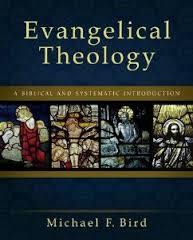
 Micheal Bird’s new volume “Evangelical Theology” promises to provide a unique and exciting contribution to the ever increasing multitudes of volumes written on the subject. Perhaps this uniqueness is best expressed in the final section of Part 1 of the book he suggests that we might consider
“… the goal of theology is not simply drawing up a list of propositions, but for us to engage in a performance of the divine drama and to experience the transformation of our imaginations so the we can know God better’
For many, both those who are academically inclined and those who are not, the clear understanding of the reasons for “doing theology” are difficult to articulate. In the opening section of this book the author does a masterful job of engaging these difficult and complex issues without either dumbing them down or rendering them outside the scope of a regular reader. He helps his readers in understanding the concept of Prolegomena by explaining “it ordinarily addresses questions like “Is there a God to be known? and How do we know God?” and then tells us “it is a bit like a shopping mall sign that says, you are here”.
He further makes the case for a specific “Evangelical Theology” holding the gospel as its central it is “ the rule of faith for evangelicals” . A clear definition of the gospel follows along with defense of the necessity of systematic theology despite his admission that it is a fallible attempt to systematize the central tenets of the Christian faith.
The section on the sources of theology is a robust defense of his contention that tradition, nature ,experience and even culture can and should be allowed to inform our study of theology while retaining the centrality of Scripture.
I certainly look forward to exploring this volume further an expect it to yield a great deal of stimulating thinking.
For the past few weeks I have been preaching on the subject of temptation under the title of “Short Cuts.” In recognizing my own capacity for “yielding” to the pervasive and persistent nature of temptation I observed what I chose to call Level 2 Temptation. This is the human propensity to respond to our yielding by sweeping all remembrance of the matter under the proverbial carpet in the hope that it will be forever erased from the memory.. The principle driving forces behind Level 2 Temptation are shame and guilt. These are first evidenced in the garden of Eden when Adam and Eve go from being “naked, but they felt no shame” Genesis 2:25 to “suddenly feeling shame” Genesis 3:7 (both NLT). This realization triggers the desire to hide and is followed by the assignment of blame by all those involved. This all falls under the overall category of attempting to sweep under the carpet. Tragically however the collection of things we keep under the carpet become arguably the most debilitating and destructive part of our lives. It has been said that we are only as healthy as our secrets and it is under the carpet that most if not all our secrets are hidden.
My understanding of this was greatly illuminated recently when Maggie and I had the privilege of attending the Global Leadership Summit. One of the sessions was lead by Dr Brene Brown, a research professor in social work from Houston. The main thrust of her work has been on the subjects of vulnerability and shame and her TED talks* on the subject are compelling (evidenced by the millions of viewings they have received). Dr Brown points out that guilt is the knowledge that you have done something bad but that shame is the overwhelming conviction that as a consequence you are bad. The answer, she suggests very persuasively, is vulnerability, the willingness to courageously turn over the carpet and deal with those festering secrets in a loving, safe and nonjudgmental environment.
Is there any greater challenge to the church family than to be such an environment? The word of God makes it clear that Jesus has provided the answer for guilt since, “when we confess our sin He is faithful and just to forgive us our sins…” 1 John 1:9 and the statement “if we are in Christ we are a new creation” deals directly with shame. So how can we seek to be this place of safety? Primarily I believe, we must be willing to be open and vulnerable ourselves. Take the courage to turn over our carpets and encourage and support each other in the process. The fewer secrets we have, the healthier a community we become. When we are honest with our struggles, we give people freedom to be honest about theirs. Healing and change only happen when things are brought into the light Loving, emotional health is one of the most attractive characteristics of individuals and their communities. Jesus’ death and resurrection have given us the hope that deals with guilt and shame. Let’s experience it ourselves and offer it to one another and resist Level 2 Temptation- keeping our carpets free from clutter!
(* This is the link I promised in the sermon “Carpet or ConfessIon”)
As I have spent time in the Psalms recently I have appreciated in a new way David giving us insight in to his prayer and worship life. Meditation has taken a very prominent part in my preparation. Campbell McAlpine in his book “Alone with God” describes meditation as “the devotional practice of pondering the words of a verse or verses of Scripture with a receptive heart” and Adele Ahlberg Calhoun in “The Spiritual Disciplines Handbook” suggests that we should ” like a cow chewing the cud, keep returning to the text with your mind and heart.” As a result of spending this time focused on the text I have re written a couple of psalms in different voices inn the pricess of grappling with their meaning for me today. I thought I would share them with you.
Psalm 8 (Roughly translated in the voice of an adopted child)
Mom and Dad, I know that this is your home and everything in it belongs to you
Even though there is no way I could have opened my mouth and asked or even suggested anything, you have used me as a demonstration of you love and care and overcome so much pain and rejection.
When I look at everything you have worked for, provided for our home its amazing you have thought of very detail.
Why you would share it with me I have no idea, but you have and you do! You told me I could treat this as my home and make use of all the wonderful things you have put in it.
You said I fit, that I belong in this special place.
Mum and Dad I know this is all yours but I am so grateful
Psalm 10 ( roughly translated in my voice)
God , how come you seem so far away from me here in Pacifica? How come you say you have a plan but you make impossible to find?
Many people round here seem to have little concern for those in our community that are really in need. They simply report the 150 homeless to the police because they don’t want them hanging out anywhere near them.
So many grand plans are made that are not designed to do much other other than to make those who make them look good.
And, they think that God is for Dummies and even if he does exist He neither notices nor cares what is going on. And sometimes perhaps I could be mistaken for one of them or at best someone who just stands, watches and finds fault …
Please God show us all how much you care, show those who ignore you that you don’t miss a trick. And show those who live for themselves that you are in charge and show those who suffer in so many ways that you have not forgotten them
And please show me how I can be part of that and give me the courage to say yes!
I found this really helpful as I seek to use these scriptures as a framework for my own prayer. Have you ever tried rewriting a Psalm in your own voice? How did it work for you?
Honestly we seem have little idea what to do with this strange day we call “Good Friday.” Growing up in England it was always a national holiday. Most, if not all, businesses closed and there was a sense of muted respect even in the lives of those for whom the message of the day was not understood. Coming to live in the US, I was initially struck by the scant attention that was paid to the day, especially by Christians. Some of the more traditional churches offered observant meditations and others held evening events but there was very little to suggest that there was anything to remember on this particular day. Remember what ?
This year, as never before, I have been impacted by the need to remember and grapple with the darkness that was such a stark reality, particularly for that little group of Jesus followers 2000 years ago. As one of them sold him, another denied even knowing Him, and all disappeared fearing for their lives, Jesus walked a lonely and agonizing path.
He endured trials that made a mockery of justice along with mental and physical abuse beyond our imagination only to be nailed on a cross. Why? Because, a few hours before, he had knelt in quiet of the garden of Gethsemane and surrendered to His Father’s plan. It was His decision and from that moment He walked with resolve and purpose into the darkness. Nothing happened by accident. He chose to grasp every moment with both hands.
So how should we, as Jesus followers today, observe Good Friday? We can learn from Peter, impetuous enthusiastic Peter who only opens his mouth to change feet! How heroic was his promise never to leave Jesus’ side but how tragic the paralyzing fear that resulted in him not only leaving him but denying that he even knew Jesus. How excruciating the moment must have been when those eyes, the eyes of his precious friend “ the Lord turned and looked upon Peter and Peter remembered”. The darkness had drawn out and revealed his self-confidence and arrogance. Not to humiliate and crush him, but to restore and heal him so he could become the pillar on which God would build the church. But for now, on the day we now call “Good Friday”, he needed to wait in the darkness and confront the truth.
There is, of course, so much to learn from Jesus. He surrendered to the will of His Father and headed resolutely into the darkness. Things did not get better. They got worse until he would gasp those final words “It is finished”. However it was that absolute trust in his Father that gave Him the strength to proceed with unwavering conviction.
We are blessed to know the next chapter and the joy and victory it brings but we should not rush past Good Friday. I believe we must pause to embrace its darkness and pain. Maybe God has something to call out of us, so that he might bring us healing and transformation. Or perhaps His purpose is to renew our confidence in Him and our perseverance so that, by truly embracing the darkness now we might celebrate an amazing Easter Sunday and be used by Him in significant ways in the future.
When He was on the way to the cross Jesus clearly envisaged a totally fresh approach to relationship for the future when he “comforted” his disciples.
I will talk to the Father, and he’ll provide you another Friend so that you will always have someone with you. This Friend is the Spirit of Truth. The godless world can’t take him in because it doesn’t have eyes to see him, doesn’t know what to look for. But you know him already because he has been staying with you, and will even be in you…The Friend, the Holy Spirit whom the Father will send at my request, will make everything plain to you. He will remind you of all the things I have told you. John 14:16-17,26 MSG
At first glance this does not seem comforting at all. Actually it seems entirely incomprehensible! Our relationships are dependent on our auditory and visual senses. However, neither eyes nor ears seem to have a significant role in the relational developments Jesus shares with his closest friends . But He clearly implies this “new” relationship will be better than their current experience of having Jesus physically present with them most of the time. How can this be? Centuries later we are still grappling for the answer.
And then there are the times He gives us a hint. Lying on a hospital bed waiting for surgery to remove my melanoma Maggie said to me that she had really sensed powerfully that these verses from Isaiah 43 were for us on that day; we read them out loud together and prayed them through.
Surgery completed and news of the melanoma having spread to my lymph nodes, I called my mother in the UK to give her the news. Within an hour she called back and said that as she was praying for us a passage from Isaiah came strongly to her mind. Yes it was the same verses from Isaiah 43:1-3a.
But now, O Jacob, listen to the LORD who created you.
O Israel, the one who formed you says,
“Do not be afraid, for I have ransomed you.
I have called you by name; you are mine.
When you go through deep waters,
I will be with you.
When you go through rivers of difficulty,
you will not drown.
When you walk through the fire of oppression,
you will not be burned up;
the flames will not consume you.
For I am the LORD, your God,
the Holy One of Israel, your Savior.
Did we “hear God or “see” him? No. Did He speak? Most certainly yes, and He made a point of reassuring us of that fact through my mother.
I am very aware that I have barely touched the reality and the mystery of this relationship that God has designed for me. However the amazing thing is that because it is not dependent on sight nor sound it can be real for each of us at the same time and all the time, regardless of our location! So let’s not give up asking Him to teach us how to experience the fullness of this new way of relating. Don’t you think, if Jesus says its better, ultimately it must be?
During this week of Prayer and fasting we are challenged to think about what is means to “deny ourselves” I found this anonymous poem which is uncomfortably relevant to the subject
Dying to Self
When you are forgotten, or neglected, or purposely
Set at naught, and you don’t sting and hurt with the insult or the oversight, but your heart is happy, being counted worthy to suffer for Christ
THAT IS DYING TO SELF
When your good is evil spoken of, when your wishes
Are crossed, your advice disregarded, your opinion ridiculed, and you refuse to let anger rise in your heart, or even defend yourself, but take it all in patient loving silence,
THAT IS DYING TO SELF
When you lovingly and patiently bear any disorder, any
Irregularity, any unpunctuality, or any annoyance; when you
Can stand face to face with waste, folly, extravagance, spiritual insensibility and endure it as Jesus endured it
THAT IS DYING TO SELF
When you are content with any food, any offering, any raiment, any climate, any society, any solitude, any interruption by the will of God,
THAT IS DYING TO SELF
When you never care to refer to yourself in conversation, or to record your own good works, or itch after commendation, when you can truly love to be unknown,
THAT IS DYING TO SELF
When you can see your brother prosper and have his need met
And can honestly rejoice with him in spirit and feel no envy or question God, while your own needs are far greater and in desperate circumstances,
THAT IS DYING TO SELF
When you can receive correction and reproof from one of less stature than yourself, and can humbly submit inwardly as well as outwardly, finding no rebelling or resentment rising up within your heart,
THAT IS DYING TO SELF
Are you dead yet?

 From the Zebra Bag