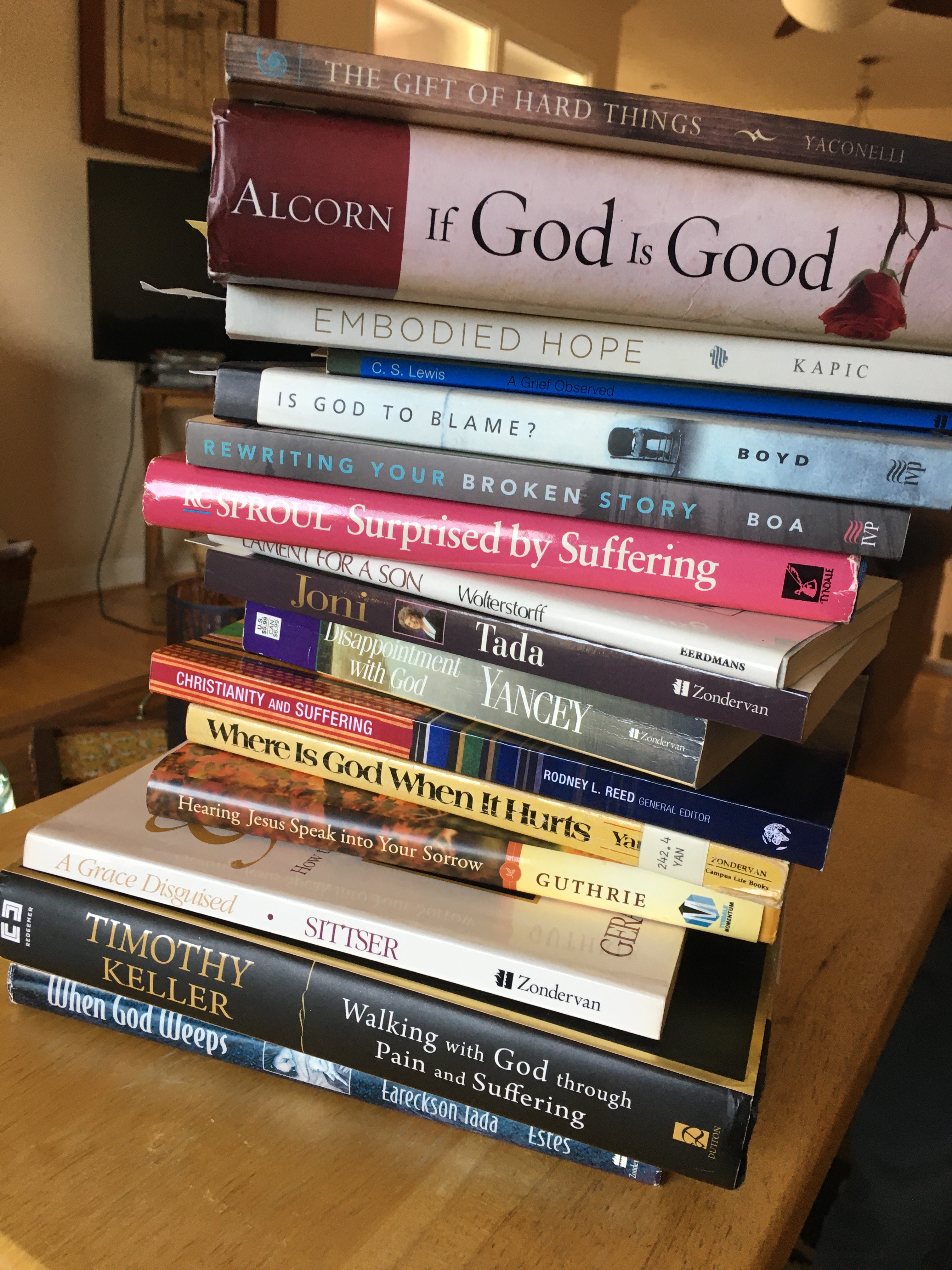
 As I began the series on The Paradox of Suffering last Sunday I mentioned that I might share here some of the books I have been reading in preparation for the series. That idea seemed to be greeted with enthusiasm so here it is! Needless to say, I have not read all of each of these books in the last few weeks but all have, over the years contributed to my thinking on this subject. (Please do add any others that have been helpful to you in the comment section and then share so others can benefit)
If God is Good- Faith in the midst of suffering and evil by Randy Alcorn https://www.amazon.com/dp/B002OK2OPS/ref=dp-kindle-redirect?_encoding=UTF8&btkr=1
Walking with God through Pain and Suffering by Timothy Keller https://www.amazon.com/dp/B00C1N951O/ref=dp-kindle-redirect?_encoding=UTF8&btkr=1
Embodied Hope- a theological meditation on pain and suffering by Kelley M Kapic https://www.amazon.com/dp/B073H5JY6T/ref=dp-kindle-redirect?_encoding=UTF8&btkr=1
A Grief Observed by CS Lewis https://www.amazon.com/Grief-Observed-C-S-Lewis-ebook/dp/B002BXH5WU
Is God to Blame? -beyond pat answers to the problem of suffering by Gregory a Boyd https://www.amazon.com/dp/B001HL0EXE/ref=dp-kindle-redirect?_encoding=UTF8&btkr=1
Rewriting Your Broken Story- the power of an eternal perspective by Kenneth Boa
https://www.amazon.com/dp/B01D8W4IKY/ref=dp-kindle-redirect?_encoding=UTF8&btkr=1
Shaped by Suffering- how temporary hardships prepare us for our eternal home by Kenneth Boa https://www.amazon.com/dp/B07V4T9FFC/ref=dp-kindle-redirect?_encoding=UTF8&btkr=1
Surprised by Suffering by RC Sproul https://www.amazon.com/dp/B0038OMK9Y/ref=dp-kindle-redirect?_encoding=UTF8&btkr=1
Lament for a Son by Nicholas Wolterstorff https://www.amazon.com/dp/B001E96QOU/ref=dp-kindle-redirect?_encoding=UTF8&btkr=1
Joni -an unforgettable story by Joni Eareckson Tada
https://bit.ly/2VNjbA3
Disappointment with God- Three questions no one asks aloud by Philip Yancey https://www.amazon.com/dp/B00UF72CMC/ref=dp-kindle-redirect?_encoding=UTF8&btkr=1
Where is God when it Hurts by Philip Yancey
https://bit.ly/2VJ7Gto
Christianity and Suffering- African perspectives Rodney L Reed general editor https://www.amazon.com/dp/B079GVPFJX/ref=dp-kindle-redirect?_encoding=UTF8&btkr=1
Hearing Jesus Speak into your Sorrow by Nancy Guthrie https://www.amazon.com/Hearing-Jesus-Speak-into-Sorrow/dp/1414325487
A Grace Disguised-how the soul grows through loss by Gerald L Sittser https://www.amazon.com/dp/B001UFMUE8/ref=dp-kindle-redirect?_encoding=UTF8&btkr=1
When God Weeps -why our suffering matters to the Almighty by Joni Erickson Todda and Steven Estes https://www.amazon.com/dp/B003OYIA3I/ref=dp-kindle-redirect?_encoding=UTF8&btkr=1
Dark Clouds, Deep Mercy – discovering the grace of lament by Mark Vroegop https://www.amazon.com/dp/B07JDDSSW9/ref=dp-kindle-redirect?_encoding=UTF8&btkr=1
Tracks of a Fellow Struggler -Living and Growing through Grief by John R. Claypool https://www.amazon.com/dp/B00295R60G/ref=dp-kindle-redirect?_encoding=UTF8&btkr=1
The Gift of Hard Things- finding grace in unexpected places by Mark Yaconelli https://www.amazon.com/dp/B01D8W6IZW/ref=dp-kindle-redirect?_encoding=UTF8&btkr=1
Hope Heals – A True story of Overwhelming Loss and overcoming Love by Katherine Wolf
https://amzn.to/2XX0gWg
What Does The Bible Say about Suffering -Brian Han Gregg
https://amzn.to/2VtBefv
(If you consider purchasing any of these for yourself and you live in Pacifica, remember that Florey’s Books is a local store that very much needs our support at this time)
I think I have mentioned a number of times in this blog that the most pressing issues for me and those finding a prominent place in my prayers surround the desire not to miss what God is teaching us through this pandemic. How will we resist the magnetic attraction to return to life as it was?
During the first week distance learning Maggie asked her classes a question. “What are you enjoying most about having to stay at home?” Far and away the most frequent answer was that they enjoyed “spending time with their family” Anyone who has been out for a walk cannot have avoided noticing the number of whole families out walking or bike riding together. Families are finding that they can enjoy doing simple things together not just occasionally but often. Children are experiencing who their parents are, maybe for the first time.
I can’t help but think that this pandemic is giving our culture an opportunity to radically review our parenting strategies.A chance to reconsider the time we actually spend giving our children our undivided attention (I am going to risk saying especially fathers). Is this a chance to rediscover the importance of what Chap Clerk in his powerful book “Hurt 2.0 – Inside the Mind of Today’s Teenagers” calls “ unstructured downtime”?
A friend forwarded me this devotional which is part of a series on “ You Version – The Bible App,” what I consider one of the greatest tools given to the church in the modern era. Here the author, Mike Novotny, expresses these concerns so powerfully. I only wish I had learned these lessons earlier in my life. If you are a parent today it is never too late, don’t let this opportunity pass you by.
“Until the Coronavirus hit, I couldn’t recall a time that my family ate breakfast, lunch, and dinner together for an entire week. Neither could I remember seven straight days of Bible study and worship as a family. But Corona changed that. Thanks, Corona!
For decades, pastors and youth leaders have prayed for fathers and mothers to embrace their God-given calling as the primary way that the Holy Spirit would lead the next generation to Jesus. The apostle Paul wrote, “Fathers, do not exasperate your children; instead, bring them up in the training and instruction of the Lord.” (Ephesians 6:4)
With our crazy-busy schedules, that rarely happens. With another weekend tournament, late nights at the office, and too many social commitments to keep, we hope that a few Sunday sermons and two years of youth group will do the trick for our kids’ faith. Sadly, as history has shown, the trick doesn’t work. Shortcuts don’t cut it in the kingdom of God.
But then came Corona. Seasons were canceled, social commitments were cut back, and life slowed down. The Sunday service pushed pause, and the youth group suspended all activities. Do you ever wonder if God was forcing our fathers’ hands and making our mothers step up and think about the eternal future of their precious kids?
If your life is anything like mine these days, you have an extra hour or two in your schedule. Leverage that time to “start children off on the way they should go,” (Proverbs 22:6). If you’re not a parent, share this message with a parent you know. Before life speeds up again, let’s remind one another that nothing matters more than people loving God with their whole hearts.
If Jesus uses a global pandemic to pass the baton of faith to the next generation, it will all be worth it.”
 It’s strange when somehow, over time, words take on totally new meanings. Who knew that being “sick” would become something to be desired and to be “lit” would be a compliment. This phenomenon struck again for me this week when a number of people posted an article on FaceBook entitled “Gaslighting. ” Much more significant, however, than the new meaning for the term, was the content of the article which I encourage you all to read.
Yesterday we heard the first reports of conversations between governors here on the West Coast about beginning to release the SIP restrictions. Of course, so much of me longs for the chance to kiss my grandchildren, hug the girls and be reunited face to face with our wonderful church family. I have missed their physical presence so much.
However, no matter how hard I try, I cannot avoid a little voice inside that is screaming, “Not yet. I am not ready!” This has nothing to do with the the virus and I will rejoice with everyone as soon as the pain and bereavement of so many begins to subside. No, this is because I am already sensing the rumbling in the distance of a freight train that these circumstances have allowed us to step off. I am not sure if I have any idea how I can prevent myself getting back on that speeding train.
My observation of the past few weeks has persuaded me that this freight train is, unbeknown to us all, hurtling towards oblivion. I believe we have been given an opportunity to step off the train, to see blue skies, experience our earth breathing and take some time to think about the things that really matter. There are reports that churches of all sizes are experiencing increased attendance, (“online” of course). Could it be that our circumstances are causing people to wonder if we really control the universe as we thought?
I am praying with a greater degree of urgency than ever, that God will show us how to stop ourselves from getting back on the train. That He would give us the courage to resist the drive to re create a “normal” that will only restore the frantic paced confusion of the past.
I recently had the privilege of hearing a message from Jill Briscoe a wonderful preacher, poet, disciple-maker and pastor’s wife. During the message she shares this poem about how God met her at a time when she needed Him most. I want to share it with you as I believe it holds some clues to where we each need to go as we search for these answers.
I ran to the deep place where nobody goes and found Him waiting there.
“Where have you been?” He asked me.
“I’ve been in the shallow places where everyone lives,” I replied.
I knew He knew. He just wanted me to admit I’d been too busy being busy. I’m running out…” I began.
“Of course,” He said. “I haven’t seen you in a while.”
He sat down on the steps of my soul in the Deep Place where nobody goes and smiled at me. Angels sang; a shaft of light chased away the shadows and brightened my daily day. I smiled back.
 “I’m such a fool…”
“Shhh,” He said, putting His finger on my lips.
He touched my hurried heart.
 Startled, it took a deep breath and skidded to a near stop. My spirit nestled in to nearness in the Deep Place where nobody goes.
My soul spoke, then: He answered with words beyond music. Where on earth had I been while heaven waited? Such grace!
When the disciple Nathaniel was informed that Jesus came from Nazareth he said, “Can anything good come out of Nazareth?” When we read through the Bible and we reach the third book of the Torah, we are tempted to say, “Can anything good come out of Leviticus?” And now there’s the Coronavirus, can anything good come from that?
At the end of the book of Leviticus, God gives Israel some clear instructions about the cultivation of the land that He was giving them. Those instructions included includes regular periods of rest for the land itself. (Lev 25:1-7). Every seven years it was to be allowed to lo lie fallow and not undergo cultivation. The principle of “sabbath” was to be applied to the earth as well as the people. These ideas have of course long past into disuse. Maybe we assumed that they were just more of the strange things that God asked the Israelites to do, but are of no importance to the present day.
It is interesting that Covid 19, while its effects are devastating for so many, has had some fascinating side effects. As a consequence of God permitting the unthinkable and the pause button being pressed for the whole of the planet, we hear that China has seen blue skies for the first time in many many years. Air quality measurements have changed dramatically. Just two examples of wider observations set out in this article in the New York Times;
In China and Italy, the air is now strikingly clean. Venice’s Grand Canal, normally fouled by boat traffic, is running clear. In Seattle, New York, Los Angeles, Chicago and Atlanta, the fog of pollution has lifted. Even global carbon emissions have fallen.
Perhaps, just as we are being given the opportunity to look carefully at the importance of rest, quiet and sabbath in our individual lives, God is also giving us a chance to recognize that the principles He gave to the Israelites for the care of the land are not so ancient and irrelevant after all.
 I saw a striking post on face book posing the question if our professional sports stars are not essential why are they our heroes and why do they get paid so much? Interesting thought, but surely a more interesting one is about those largely unknown people who have suddenly become our heroes. The grocery clerks, healthcare aids, teacher/Moms and so many others. These people and many others like them have been plummeted into the front line where there is real danger and the need to work harder than ever.
One of our church family posted this wonderful prayer for these unsung heroes and in case you missed it I wanted to share it with you. The question is how can we make sure that these people each of whom has a name, who were serving us faithfully before this crisis are not taken for granted in the future?
Bless the merciful
A Sunday Blessing
By: Sarah Bessey
March 29, 2020
Oh, God. Bless the merciful. Bless them.
Bless the hospital chaplains who are crying and praying in trauma rooms with the scared and the hurting. Bless the doctors and the nurses, the janitors and the lunch ladies, the front-line workers and behind the scenes faithful ones during this terrible time. Bless the ones in the nursing homes with lonely seniors, putting themselves at risk to keep caring for the vulnerable. Bless the families on the other side of the window glass with phones, smiling and waving and holding up signs of love to their elders. Bless the vulnerable and at-risk and those who open their doors to them even in the midst of a pandemic. Bless the scared kids and the adults who notice them.
Bless the ones who cry too much and feel too much. Bless the wounded healers.
Bless the kind ones, who speak words of life and gentleness. Bless the benefit-of-the-doubt givers, the one-more-chance lavishers. Bless the comforters and the kleenex-passers. Bless the walkers-in-another’s-shoes. Bless the wheelchair pushers. Bless the ones there waiting after the chips fall, and the edifice crumbles, and the truth comes out. Bless them for their grace for both the flyers and the thud-ers, for the fury and the glory. Bless the ones baking bread and leaving it on doorsteps for the parents they can’t risk seeing. Bless the ones who serve without fanfare or book deals or media attention. Bless the ones who love vulnerable children, day after day after day. Bless the ones who are lonely and alone, who are isolated and vulnerable, who are struggling to breathe.
Bless the ones who lavish grace and bandage wounds and figure out how to make ventilators in factories. Bless the ones who intubate and the ones who are crying in the stairwell, overwhelmed by caring. Bless them for they give dignity to the rest of us. Bless them because they see us and they love us anyway.
Bless them for standing in our thin places between too-much and not-enough, the places where our hearts are breaking and our fears are manifesting and we are so scared and so alone. Bless them for being the ones that show up in the fault lines to hold our hands and pray and weep with those who weep.
Bless them for their patience, for their uncanny ability to just keep going, for their ability to be present instead of checking out for something less demanding. Bless them for long days on their feet in uncomfortable PPE gear, sweaty and exhausted and filled with mercy for us anyway. Bless them for their determination in the face of suffering, for the patience in the teeth of our it’s-going-to-get-worse predictions, and their faith in our story.
Bless them for their heart to ease the suffering, to smooth the edges, widen the roads. Bless them for their cups of cold water, and their plates of food, for their prison visiting, for their preemie-baby hat knitting, for the signs in the windows saying “thank you, essential workers!” decorated with stickers and glitter. Bless them for the healing work of their gifts. Bless them when they smell of salt tears and someone else’s sh** and our unwashed bodies. Bless the funeral workers and the priests who have run out of words. Bless the journalists and politicians who are wise and merciful, the public health officials and the sign language interpreters. Bless the site preppers and the cleaners. Bless the merciful because they are so often the only glimpse of goodness.
Bless the merciful as they carry our own burdens with us; we cannot know how low they are bowed with the grief of the whole world groaning for healing and hope even as they keep moving forward. Bless them in their anger. Bless them in their frustrations. Bless them in their fears. Bless them in their exhaustion. Bless them when they are overwhelmed and want to quit. Bless their sleep and their rising.
Bless the ones who care for the ageing and the dying, for those making the way a bit smoother for the families left behind. Bless the ones who hold the hands of the poor and broken and you and me. Bless the ones running right towards the hurting with their hands outstretched.
At the end of all this may we bless them with rest and gratitude, with compassionate and generous policies and pay, with just systems and actions. At the end of all this, may they know they were our heroes not in spite of their weakness and humanity and moments of breaking but because of them. At the end of this, may we value love and mercy.
Bless them because it takes more courage and strength to be merciful, compassionate, and kind than we could have ever imagined. May they find love and strength, courage and compassion at their rock bottom.
In our Zoom hang out after church on Sunday we were sharing how hard it is for some of us to stay at home and feel like we are doing nothing while some are having to work harder than ever. They’re having to encounter real danger as part of their daily routine. This would have been unthinkable just a few weeks ago let alone when they filled out their application. In the course of the conversation it was pointed out that the reality is, staying at home is, in itself, making a real contribution to stemming the tide of this virus.
As I thought about this later in the day it reminded me of the command God, through Moses, gave to the Israelites as they left Egypt. Confronted with the Red Sea in front of them and an advancing Egyptian army behind them God says “Don’t be afraid, just stand still and watch the Lord rescue you today” Exodus 14:13. In the Psalms, we are urged to “Be still and know that I am God.” The truth is, it’s the “being still” and “standing still” that is so difficult and make us feel that we are not contributing.
Could it be that being and staying still is one of the lessons that we are able to learn by experience as we stay at home? The interesting thing is that I often overlook the rest of Psalm 46:10. It goes on to say “ I will be honored in every nation.” Surely the implication is that if we are not still, we run the risk of getting in the way of His being “honored among the nations.” If the Israelites had decided to take action they would certainly have obstructed the plans that God had for their deliverance. And it was the news of that deliverance that spread among the nations and brought Him honor and glory.
Those of us who play our part by staying at home have the opportunity to understand the “being still” is a crucial part of “knowing He is God” It is just an opportunity to observe. It is by being still when we are told to do so, that we are actively allowing Him to run the universe. Sometimes He asks us to participate, on other occasions he simply asks us to stay out of the way. So to those who are currently staying out of the way, thank you for doing your essential job so well!
At New Life we have just finished a sermon series where we thought together about what it meant to be the church rather than go to church; How to be part of the fulfillment of Habakkuk 2:14 , filling the earth with “the knowledge of the glory of God.” How can we do that by intentionally infusing the activities of our daily lives (our rhythms) with the gospel? We have looked at incidents in the life of Jesus along with “Saturate” by Jeff Vanderstelt as we have learned together. One of our church members, Shaloni Jeet, shared with me a beautiful poem she wrote inspired by what we have been learning. So I asked her if I could share it with you.
Welcome to your table
To break a bread with someone
Share joy, pain, and all the ordeal
Over a simple meal


It may seem ordinary
But a huge weight it will carry
For once if you could free
someone of their solitary


Lend your ear always
To the broken and the healing
What peace they will get
When they reveal to you their feelings


If someone shared their deepest thoughts
It is you who is blessed
For you had an ear for listening
And not a judging heart you possessed


The story of the greatest hero
Who is brave and bold
With his blood he saved the world
Share the greatest story ever told


Share your testimony without hesitation
With all those around
It may bring someone to their salvation
So that they may be also found


Bless others with what you are endowed with
Your time, skills or riches, as you please
Share with all while you can
It's here today, tomorrow it may cease


Celebrate with others each day
For you have Gods permit
It is the day the Lord has made
Be glad and rejoice in it


Rest in the Lord as you work
He will make everything perfect
He will renew your strength
And through you, his wonderful work will reflect


Through everyday stuff you be the church
And let the message pass through
That you don’t have to go to him
Just call out and Jesus will come running to you!

Aravs Mum. 03/24/2020
Inspired by "Saturate" by Jeff Vanderstelt
How long will this strange situation last? We don’t know, but we do know that it will not last forever. The question that troubles me repeatedly is, “What is going to be different when we do return to normal? Are we going to rapidly return to the old way of doing things and before we know it the challenges of Sheltering in Place will be little more than a memory?
At New Life we begin each year with 21days of prayer and fasting. Many of us stop some of our regular, even habitual, activities to pay more focussed attention to the plans God has for the year to come. The question however is. how many of those changes would God have us make permanent.
Some of us are currently facing the pain of being without work because our employment is not deemed “essential”. That is painful enough by itself, let alone when you are wondering how to pay the bills. On the other hand, some feel they are working harder and longer than before Shelter in Place. Most of us, however, are working differently.
All of us (hopefully!), rather than leaving our workplace for a litany of frenetic activity, are returning home to spend time with our families. We have been forcibly reintroduced to “unstructured down time.” Families have discovered one another again and remembered that they quite like each other! Books with layers of dust have been opened and found to be really engaging.
How often have we bemoaned our packed schedule, busyness and unrelenting tiredness wondering if there would ever be any relief? Somehow it seems God has pressed a world wide “pause button” which a short time ago would have been inconceivable. I am not suggesting God designed or created the virus but it seems He has permitted a fundamental challenge to the entire world’s way of life. Could it be that He is offering us the chance to change.
I have been really struggling with this. I can embrace the idea that change needs to happen, but when I try to tie myself down to actual practical details, I find myself floundering in the dark. However this morning in the shower I had a thought that gives me just a pin prick of light at the end of the tunnel. I remembered the advice Dallas Willard gave John Ortberg when he inquired as to the priorities he should have during a sabbatical. Willard famously said “Ruthlessly eliminate hurry from you life”. Isn’t there a sense in which this is what has been forced upon us, at least partially, in the last couple of weeks?
It occurred to me that I can reduce the prevalence of “now” in my way of life; I must do that “now,” respond “now”, decide “now” and so on. How many of these really require to be done ”now”? Can I structure my calendar in such a way that there is more space and so reduce the recurrent sense of urgency and immediacy? I am not really sure how that might work but it may be a start. What about you? Do you have some ideas to share?
I am so proud and appreciative of our church family for the ways in which you are all working so hard to shelter in place, social distance and live within the orders we have been given. For many of you this causes immense frustration and hardship, so thank you on behalf of us all
I was wondering how many of you have read the most recent circular for our County Health Officer Dr Scott Morrow. As I read it I think I began to appreciate the conflicted emotions that he expresses
“As I write this, I am both immensely grateful and exceedingly disappointed. We are in a grave crisis”
I am grateful that many people are taking this seriously and are doing everything they can to slow the spread of this virus. You are heroes for doing this.
I am deeply grateful for and everyone should thank God for our first responders and our front line medical and public health personnel. They are taking on personal risk to take care of you. They are heroes for doing this.
My disappointment stems from the fact that many people just aren’t taking this seriously and going about their business as if nothing has changed.
In my reading through the Bible this year this morning I began the book of Deuteronomy. Of course, this awakened so many memories of our journey through the book together at New Life last year. But what struck me this morning was the similarity between what Dr Morrow says and the message Moses decays to the Israelites. “If you want to be safe”, Dr Morrow says, “you must ALL follow the guidelines otherwise you show great disrespect for the community”. “If you want to experience a land flowing with milk and honey”, says Moses, “you must follow the laws God has set out for you.”
What a challenge this is to our cultural obsession with “independence” and what we call “freedom.” Could it be that through this difficult time God is giving us an opportunity to rethink the degree to which we both value and recognize how much we need to prioritize our communities’ needs before our own? What do you think?
Probably no coincidence that as I read “ The Daily Office” during my devotions each day this week I have come to the chapter entitled “ Growing through Grief and Loss” It has impressed on me that this is exactly what many of us are feeling right now. Here are just a couple of quotes :
“ Experiencing loss makes us confront our humanity and our limits. We quickly realize we are not in control of our lives; God is. We are creatures not the Creator”
“ We don’t become mature human beings by getting lucky or cleverly circumventing loss, and certainly not by avoidance or distraction. Learn to lament.” Eugene Peterson
Many have lost jobs, at least for the time being, with no knowledge of when work will restart. Many are feeling lonely and disconnected wondering how they can maintain relationships in any meaningful way. How will bills get paid? Will people forget me completely. All these fears and so many more are real and legitimate and need to be confronted. It’s not that the fact that God is in control and will work all things for good is not real, it’s just that it takes time for that message to travel from our heads to our hearts. And that is ok.
In the meantime we must first confront the pain and fear and feel all the emotions these unsettling circumstances bring to the surface. Express that emotion in all its raw reality to God, He can take it. Then and only then, when we have fully engaged with all that emotional reality, can we open the door to embrace the new reality with all its possibilities.
When Jesus tells repeatedly to “fear not” He does so because He knows how relentlessly fear and insecurity rises within us. He does not say we are bad or wrong to feel that way. He does not say stuff it away in a place where hopefully you can forget it. He does not say forget it and get on with life. He simply says face it and recognizing it, hand it to me. I will take it and walk with you through it. I will take you to a place where you have no need to pretend but rather have confidence and trust we can face it together.
So, as we seek to maintain contact and connection with each other, let’s encourage one another to face the challenges with honesty. Then, I believe we will experience the joy and peace that passes understanding in fresh and amazing ways. In time, our Heavenly Father will enable us to deepen our faith and trust in Him. Also, He will teach us new ways to face the future that we will, in turn, be able to share with others.

 From the Zebra Bag